I recently came across this list on Forbes on the largest 25 tax payers. Forbes does a bit of analysis on each of them. It is probably worth your time to jump over, but I thought I would give the highlights here:


Rank of tax expense

Company

Symbol

Effective Tax Rate

1 ExxonMobil XOM 39%
2 Chevron Corporation CVX 43%
3 Apple Inc. AAPL 25%
4 Wells Fargo & Co. WFC 31.2%
5 JP Morgan Chase & Co. JPM 26%
6 Wal-Mart Stores WMT 31%
7 ConocoPhillips COP 51.5%
8 Berkshire Hathaway Inc. BRK 28%
9 IBM IBM 24%
10 Microsoft Corporation MSFT 22.8%
11 Philip Morris International Inc. PM 29.5%
12 Goldman Sachs GS 33%
14 Comcast Corporation CMCS 32%
14 The Procter & Gamble Co. PG 23.5%
15 Johnson & Johnson JNJ 23.7%
16 Intel Corporation INTC 23.6%
17 Occidental Petroleum Corp. OXY 42%
18 UnitedHealth Group UHG 35.9%
19 The Walt Disney Company DIS 32.7%
20 AT&T T 27.8%
21 Oracle ORCL 21.4%
22 The Coca-Cola Company KO 23.1%
23 The Home Depot Inc. HD 37.2%
24 McDonald’s MCD 32.4%
25 Google GOOG 19.4%

Gold prices have dropped a bit in the last couple months. This has caused some consternation among some investors. This is utterly foolish!

My gut is investing in gold right now is not particularly logical. It unquestionably is trending down. That is unwelcome news for some of the gold mines, but it is hardly a concern for a Confident Investor. We can easily invest in other companies that are doing well and are not subject to the whims of a commodity price. If you read this site even for a short time, you should know that I don’t like a “Buy and Hold” investment strategy.

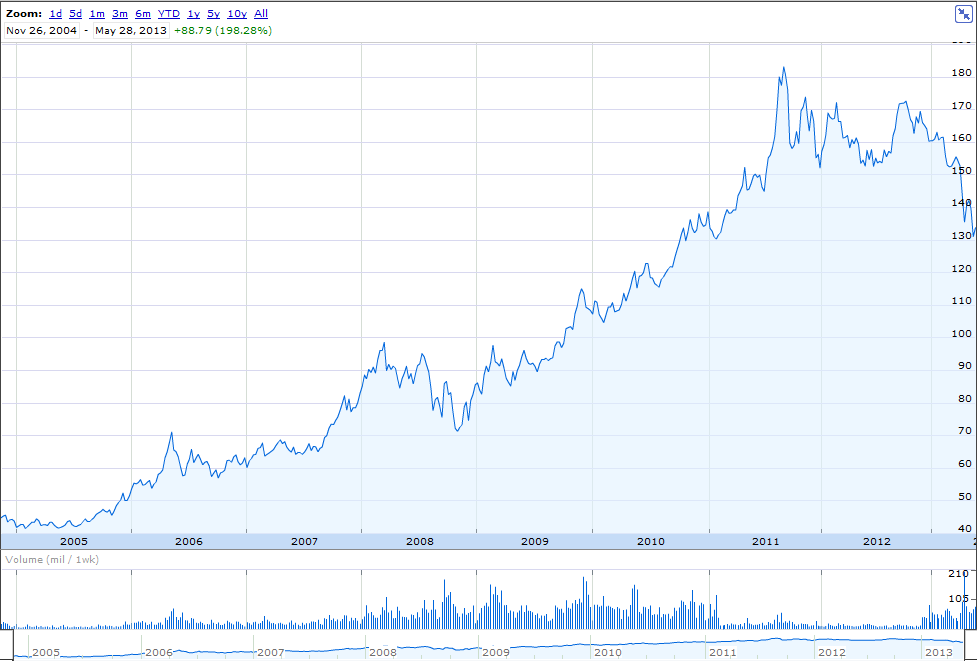
Historically, gold was used as a safeguard against risk in the financial world. It was seen as a safe harbor when there was uncertainty in other investments. This was one of the principal reasons given when gold was growing so quickly from the beginning of 2006 to mid-2011. Then as the economy stopped hurting so badly, the price leveled off in late 2011 and 2012. It is not surprising, in fact it is expected, the price would drop with a stable economy.

As we look at the Gold ETF [stckqut]GLD[/stckqut], this is exactly what we see. There is quite a bit of volume as the price increases into 2011. Then, the volume drops substantially as the price oscillates in a sideways channel. Now the volume has increased as the price drops. What this shows is that money was flowing into this investment vehicle, it was be held, and now it is flowing out. The new home for that money is not currently clear but maybe it is the reason the stock market has been breaking records lately.

NYSEARCA GLD SPDR Gold Trust ETF from Google Finance

Many will point out that the economy is not as strong as it could be. That is fine. I won’t argue that point. However, the economy has been fairly stable for at least the last 12 months with a extremely slow recovery and painfully slow reduction in unemployment. The economy is not getting worse, and by most measures it is holding its own or slightly improving.

A while back I suggested that you should not invest based on politics or economic announcements. Gold is an economic announcement. You should watch it and understand it, but trying to decipher how it is going to move Google [stckqut]GOOG[/stckqut], Apple [stckqut]AAPL[/stckqut] or Ebay [stckqut]EBAY[/stckqut] is a fool’s errand.

Editors Note: An investor needs to be very concerned about having too many stocks that are influenced by the same market factors. Understanding these relationships can be confusing at times. This guest article by Troy does an excellent job of helping to explain this concept.

Guest Post by Troy Huot

Why do stocks trade up? Why do stocks trade down? When you invest in a stock you need to comprehend what jolts the equity you’ve investing in either higher or lower. One contributing factor may have nothing to do with the stock you own at all.

Arbitrage is not usually the reason your beloved stock gets hammered on any given day. The old adage, “everything happens for a reason” definitely holds true in relation to the stock market. Stocks trade in unison and typically stocks trade in unison by sector.

Stocks can be divided up into many sectors based on the type of business the company is involved in. Some sectors include, but are not limited to: energy, financial, health care, industrials, retail and technology. It is imperative that you know what sector your stock belongs to as the stock can increase or decrease in value based on competitors in their sector.

For example, Apple is in the technology sector and its direct competitors are Dell [stckqut]DELL[/stckqut] and Hewlett-Packard [stckqut]HPQ[/stckqut]. News could come out that Apple Macbook Pro computer sales are going to be lower than expected this quarter. As a result, the stock could sell off drastically. You could trade the news on Apple [stckqut]AAPL[/stckqut] knowing there is also a possibility that both Dell and Hewlett-Packard could decrease in price too. Why? Because investors will insinuate that the decrease in sales for Apple is a foreshadow for dismal computer sales for both Dell and Hewlett-Packard. This has a direct impact on all the companies which leads to a rainfall effect that could send all three stocks trading lower.

There are also many other indirect stock market links that investor’s must pay attention to. Apple and Hewlett-Packard may be directly connected but companies like Apple and Omnivision Technologies [stckqut]OVTI[/stckqut] have an indirect relationship. Omnivision Technologies creates and manufactures a semiconductor image sensor for the camera used in Apple iPhones: do you see the relationship here? It could come to light that iPhone sales have increased dramatically from first quarter to second quarter. This could lead to Apple’s share increasing in price as well as Omnivision Technologies stock since Apple uses Omnivision’s product in their iPhone.

Stocks trade higher and lower based on several other reasons including current commodity prices. If you are an owner of apparel maker, Lululemon Athletica [stckqut]lulu[/stckqut], then it is in your best interest to monitor the price of cotton. If the price of this commodity escalates, odds are Lululemon will trade lower due to the fact the company now has to pay more money to purchase cotton. Cotton is the main fabric used in clothing so it’s price can have a huge positive or negative impact on retail companies. If cotton costs increase for a clothing company but the price of merchandise sold remains the same then profitability will decrease which might disgruntle investors. A company like Lululemon can not simply just increase their price of a hoody or yoga pant either. Doing this could lead to losing customers to competitors which would hurt the company even more. Many clothing manufacturers like Nike [stckqut]NKE[/stckqut], Under Armour [stckqut]UA[/stckqut] and True Religion [stckqut]TRLG[/stckqut] could also perish from higher commodity prices and this is why stocks in similar sectors tend to trade together.

As an investor you must always be observant and understand direct and indirect relationships between companies that makes stocks trade together. This will indubitably help make you more money during your investing lifetime. Nonetheless, this will also help prevent you from making some terrible mistakes in the future which will have a direct, and indirect, impact on your bank account.

Like what you read? Find more related articles and content at http://www.conquerinvesting.com

Article Source: http://EzineArticles.com/?expert=Troy_Huot

Company name Apple Inc.
Stock ticker AAPL
Live stock price [stckqut]AAPL[/stckqut]
P/E compared to competitors Good

MANAGEMENT EXECUTION

Employee productivity Good
Sales growth Good
EPS growth Good
P/E growth Poor
EBIT growth Good

ANALYSIS

Confident Investor Rating Good
Target stock price (TWCA growth scenario) $664.33
Target stock price (averages with growth) $1015.74
Target stock price (averages with no growth) $883.31
Target stock price (manual assumptions) $540.31

The following company description is from Google Finance: http://www.google.com/finance?q=aapl

Apple Inc. (Apple) designs, manufactures and markets mobile communication and media devices, personal computers, and portable digital music players, and a variety of related software, services, peripherals, networking solutions, and third-party digital content and applications. The Company’s products and services include iPhone, iPad, Mac, iPod, Apple TV, a portfolio of consumer and professional software applications, the iOS and OS X operating systems, iCloud, and a variety of accessory, service and support offerings. The Company also delivers digital content and applications through the iTunes Store, App StoreSM, iBookstoreSM, and Mac App Store. The Company distributes its products worldwide through its retail stores, online stores, and direct sales force, as well as through third-party cellular network carriers, wholesalers, retailers, and value-added resellers. In February 2012, the Company acquired app-search engine Chomp.


Confident Investor comments: At this price and at this time, I think that a Confident Investor can confidently invest in this stock.

If you would like to understand how to evaluate companies like I do on this site, please read my book, The Confident Investor.

It is no secret that two of the hottest stocks in technology are Google [stckqut]GOOG[/stckqut] and Apple [stckqut]AAPL[/stckqut]. Google leads in market share between the two companies by offering the Android OS, which is free. Which causes an investor to wonder, is Google really capitalizing on the mobile trend that it is leading?

This infographic from Wordstream shows that Google does just fine in capitalizing on the mobile market.

Google mobile solutions
Find out how Google’s mobile solutions could work for your business.