CNET recently put out an article discussing the most profitable US corporations. The article shows that even with Apple’s disappointing quarter that caused a major drop in stock price, Apple is still had more income than anyone else. The issue is that the analysts thought that the results were going to be even better, so the analysts were disappointed. When you disappoint analysts, they punish you by saying bad things. I am borrowing the great CNET chart below.


Apples disappointing quarter in context chart


To this analysis, I would like show how cheap these stocks really are. While I try to not compare the P/E ratio of non-competitors, I think it is valid for this one exercise.

If we look at the P/E and EPS of these companies, it is quite telling how cheap Apple really is among this peer group.


Company

Symbol

P/E

EPS

Apple Inc.

AAPL

9.78

44.10

Exxon Mobil Corporation

XOM

9.17

9.69

Microsoft Corporation

MSFT

15.39

1.82

Pfizer Inc.

PFE

22.36

1.26

International Business Machines Corp.

IBM

14.57

14.41

JPMorgan Chase & Co.

JPM

9.64

5.20

Wells Fargo & Co

WFC

10.85

3.36

The Procter & Gamble Company

PG

19.76

3.90

General Electric Company

GE

17.08

1.39


It might not be obvious from looking at the above table of values. Looking at P/E as a chart shows that Apple is one of the cheapest stocks by comparing its price to the earnings of the company.
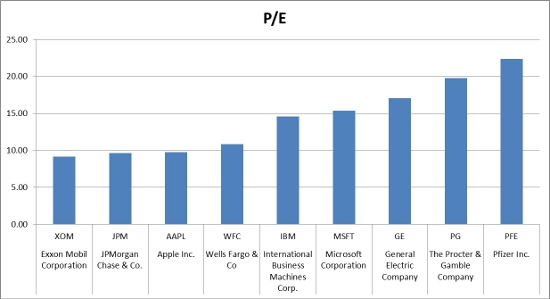
Apple's PE compared to the most profitable companies


It really becomes obvious then by looking at the earnings per share in chart format!

Apple's EPS compared to the most profitable companies


So if you think that Apple’s days are done, you may want to think again! In fact, the biggest complaint that you can say about Apple is it seems that they are not getting enough shareholder value! 

If you think that IBM is fairly priced for its earnings then it would be realistic that Apple could increase its share price by 50% if you focus on P/E! By looking at Microsoft, you could say that the price could go up 60%! This means that it is likely that Apple has more upside potential than downside risk.

My disclaimer on this site consistently says that I ‘might’ be long any stock I talk about. In this case, I am long on Apple as I write this article. However, as I consistently point out in my book, The Confident Investor, I didn’t pay for those shares! My current Apple holdings are all free.  If you want to know how to get free stock in great companies, I suggest that you read my book. You can purchase my book wherever books are sold such as Amazon, Barnes and Noble, and Books A Million. It is available in e-book formats for Nook, Kindle, and iPad.
I encourage people to ask me questions about my book, The Confident Investor, or about the stock market, in general. I am open to questions from Twitter or on this site. I recently received a question about stock splits. The basic question asked if it was a good time to buy immediately after a company split its stock. The purist answer is that it shouldn’t matter but that may not be the complete answer.

First, a bit about stock splits. Companies split shares of their stock to try to make those shares more affordable to individual investors. When a company does a stock split, its share price will decrease, but the market capitalization of the company will remain the same. For example, if you own 100 shares of a company that trades at $100 per share and the company declares a two for one (2:1) stock split, you will own a total of 200 shares at $50 per share immediately after the split.

The reason for stock splits has dropped over the years. Before the advent of easy trading brokerages on the Internet, it was not uncommon to see penalties for buying shares in increments other than 100 shares. With this penalty removed, individual investors are free to invest the amount they can afford – $1,000 of a $10 stock (100 shares) is just as easy to buy as if that stock was $25 per share and the individual investor only purchased 40 shares. This is mostly irrelevant to “institutional investors” that may be buying millions of dollars of a stock.

Some companies now avoid stock splits altogether. The theory is that the stock split doesn’t matter so why do it. Also, if the company is catering more to institutional investors rather than individuals, then the higher stock price doesn’t matter. As further benefit, the higher stock price eliminates some trading strategies and effectively encourages longer term holders of a stock. Some companies like to have a higher per share price and almost carry it as a badge of honor – Google [stckqut]GOOG[/stckqut], Apple [stckqut]AAPL[/stckqut] and Berkshire Hathaway (BRK-A) being 3 of the most well known with a high stock price. To be honest, a higher stock price even slows down the effectiveness of my program described in my book, The Confident Investor. If you want to learn more about my methodology, you can purchase my book wherever books are sold such as AmazonBarnes and Noble, and Books A Million. It is available in ebook formats for NookKindle, and iPad.

Now to the original question. Should you expect a bump up after a split. The purist answer is no since there is no additional value or wealth being created with a stock split. However, a study of the performance of 2,750 companies from 1975 to 1990 conducted by Rice University professor David Ikenberry found that shares climbed, on average, about 3.4 percent in the days immediately following a stock split.

I could easily argue that this Rice University study is too old to be relevant in the 21st century. This time frame for the study was during the penalty of non-block size trading. It was also a time frame when trades were measured by eighths (1/8) rather than to the penny as they are now (this change happened in 2001).

Bottom line, there may be a small bump up when a stock splits but the markets are efficient enough that this will only be short term and likely not worth trading.

Many readers have reached out to me to ask about how to run a balanced portfolio. This article is designed to help you with general guidelines for developing such portfolio. A balanced portfolio should be 20-40% in index funds and 60-80% in individual stocks spread out among many industries. This allows you to have exposure to the general market, the international market, and the growth of truly well-run companies. The proportion of money between index funds and individual companies should be dictated by your age and how soon you will need the money to pay for life’s expenses.

The first thing to do is invest 20 to 40% of your portfolio in index funds. Divide these index funds into at least four categories:

  • international funds
  • bonds funds
  • small-cap or mid-cap funds
  • large-cap funds

I suggest that you balance your fund investments equally every year. This means that you would have 5% of your portfolio in each fund category. You may have to annually add money from the individual stock 80% of your portfolio to maintain at least 20% index fund exposure.

It really doesn’t matter which company manages the index fund you choose. There is some variation in international funds since they can track many different markets so you may need to study a bit for that component. There is little true variation in bonds funds so just find one that tracks the Barclays Capital Aggregate Bond Index. For the stock index funds, they should track one of the S&P indexes or one of the Russell indexes.

If you are over 65 then you may want to start dropping down to 60% of your portfolio being in individual stocks and 40% index funds. You definitely want to consider this if you are over 75 years of age. However, if you are under 65 then you probably should have a portfolio of stocks that is approximately 80% of your portfolio. At 65 you may think you need to be more cautious but there is a high probability that a 65 year-old person is going to live to be 90. If you have reached the glorious age of 75 then you are even more likely to live to 90.  With 25-45 more years of spending to do, you really need your money to continue to grow even if you are retired. As you approach 80 or 90 years, you may want to have a more even mix of stocks, bonds, and money-market cash. To understand this better, check out my whitepaper, Retire In Luxury.

Divide 80% of your portfolio into equal allotments that are larger than $5,000 per allotment. You should have at least 10 allotments in a balanced portfolio. You could have 20 or 30 allotments depending on the size of your portfolio. If you do not have $50,000 to divide 10 ways then divide your existing portfolio into $5,000 increments. You will find that you are much more efficient and profitable if you invest $5,000 or more using GOPM. If you have fewer than 10 allotments, be very diligent about getting a good mix of industries so that you are not overly hurt by any one trend.

Regardless of the number of allotments that you choose, you need to choose twice that number in stocks that you are tracking.  So if you have 10 allotments, you should track 20 stocks. This allows you to always have a stock that is rising to invest your money. Invariably, some of your tracked stocks will be going sideways or down but by tracking double the number you need, you are likely to have 10 that have upward momentum.

You should plan on investing in 10 to 30 companies at a time using the tools that I show in The Confident Investor. Grow your investment in any individual stock until you have doubled your money using GOPM (Grow on Other People’s Money).

When you have doubled your money in half of your companies, you may want to consider changing your allocation size to a larger allocation. This will allow you to continue to grow your investment in those great companies.

It is also possible to stop investing in any given company at half of an allotment or twice allotment depending on how you feel about that company. You should also factor the number of companies in the same industry you already having a portfolio. For instance, if you have 2 companies in nearly every industry except you only have one mining company, feel free to allow that mining company to grow to a double allotment. Similarly, if you have 3 software companies in your portfolio then you may want to limit one or all of them to a half allotment so that your portfolio is not overweight in that category.

Let me show you an example of a 50-year-old man (we will call him Bob) that has been able to save $150,000 in his IRA account.

  • $7,500 in an international index fund
  • $7,500 in a bond fund
  • $7,500 in a small-cap  or a mid-cap fund
  • $7,500 in a large-cap fund
  • $120,000 divided into 10 allotments of $12,000 each.  This means that Bob will purchase up to $12,000 in any stock on the 20 possibilities.

For the 20 stocks, Bob chose the following from the Confident Investor Watch List:

Apple Inc. Technology – Personal
Akamai Technologies Technology – Internet
Ansys, Inc. Technology – Enterprise Software
Atlas Pipeline Energy
Caterpillar, Inc. Manufacturing – Machinery
Chipotle Mexican Retail – Restaurant
Cirrus Logic Technology – Semiconductor
Deckers Outdoor Footwear
Ebay Inc. Retail – Web
Extra Space Storage Real Estate
Goldcorp Inc. Mining – Gold
Google Inc. Advertising – Web
Hms Holdings Corp Healthcare – Services
Helmerich & Payne Energy
Merck & Co., Inc. Pharmaceutical
Net Servicos de Comunicacao Telecommunications – International
Priceline.com Inc. Retail – Web
Boston Beer Alcohol Beverages
Washington Banking Finance
Yum! Brands, Inc. Retail – Restaurant

Bob will invest in these companies as indicated by the technical indicators described in my book, The Confident Investor.  You can purchase my book wherever books are sold such as Amazon, Barnes and Noble, and Books A Million. It is available in ebook formats for Nook, Kindle, and iPad.

I frequently get questioned about how to account for stock buy backs and dividends when analyzing a company. I am going to save dividends for another article and just concentrate on stock buy backs. I will start this discussion with a great quote from Dr. William Lazonick of University of Massachusetts:

“Here we have all these companies obsessed, basically with keeping their stock prices up, and saying the best thing that they can do with their money is spend billions of dollars on stock. And my view of that is, any company that says that they have nothing to better do with their money, the CEO should be fired.”

While many will say that this is an extremely strong statement, I believe that Dr Lazonick is not that far off from the truth.

There are many ways that companies can use their cash that helps the long-term success of the company. Among these are:

  • R&D for new products – This helps the company have a competitive advantage in its market in the future.
  • Increased pay and benefits for employees – While we don’t want our companies to give foolish salaries we do need them to have happy employees that are loyal to the company’s success. In nearly every company – turnover is expensive.
  • Invest in the infrastructure of making their products – Apple [stckqut]AAPL[/stckqut] has made a science of this technique. It regularly helps its suppliers with acquiring the manufacturing tools required to produce great products.  Apple also will commit to large orders and effectively buy up the supply of emerging technology.
  • Acquire new products and technology through mergers and acquisitions – Effectively, the more cash on hand a company has, the more flexibility the company has in doing deals that can dramatically accelerate new products and new markets.

If we re-examine Dr. Lazonick’s quote, it now begins to make sense. A stock buy back plan basically means the company has run out of ways to effectively invest in the long-term prospects of the company. Rather, it is trying to shore up its stock price in the short term. Is this in the best interest of its shareholders or just the stock options of the executive committee?

Many times this shoring up doesn’t even work that well.  According to Fortuna Advisors: “…research shows high return companies create the most value for shareholders when they deploy more capital in growing their operations rather than giving it back to shareholders.”

Recently, the Wall Street Journal pointed out that many times the buy back programs don’t even change the amount of stock outstanding. It seems that it is not uncommon that the buy back is offset by stock grants to favored employees.

I hope that you listen to the quarterly comments of the CEO of each of your holdings. When you are listening to those comments and he or she discusses stock buybacks as a way to boost value to the shareholder, you should be actually hearing, “We have a lot of money burning a hole in our pocket and we are not smart enough to profitably use it, so we are doing a stock buy back!” Or, maybe the CEO is saying, “I dare you to fire me based on the advice of Dr. Lazonick!”

The goal of my book, The Confident Investor, and this site, is to help you find great companies and then grow your investment in those companies by using other people’s money (GOPM). I don’t pay attention to the buy back announcements of companies. I assume they are doing the buy back simply because it is the popular thing to do. I refuse to reward them for this activity but I am pragmatic enough to not penalize them.

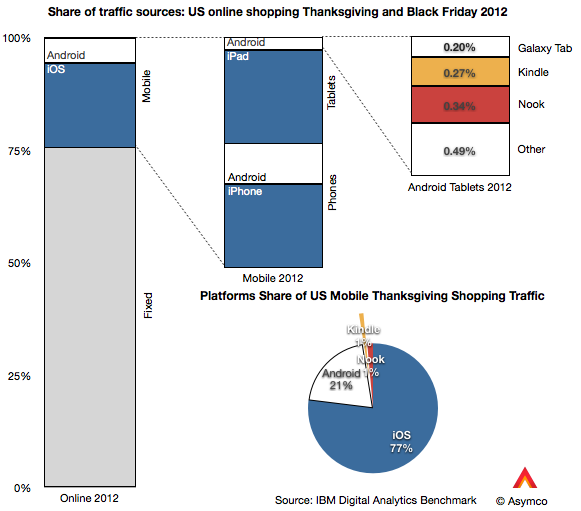
Part of the reason that Apple [stckqut]AAPL[/stckqut] has had such an amazing stock price run the last 2 years (even with the drop of the last 2 months) is the usefulness that its users derive from the iPhone and the iPad. This study from Asymco shows that the Apple’s influence on eCommerce exceeds its market share by a significant margin.  For your convenience, I am reproducing the analysis chart here. The commentary on Asymco’s site is worth clicking over and reading.