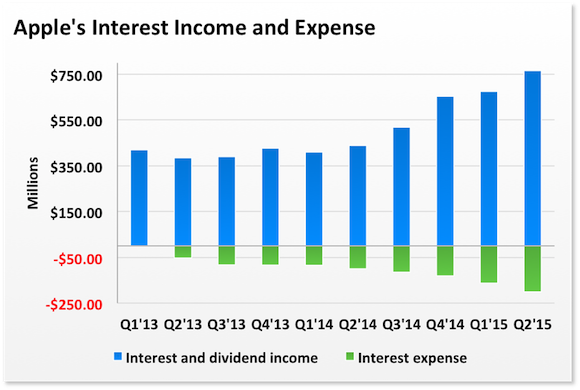
Over the past few years, the richest company in the world has continued borrowing increasing amounts of money from all over the world. Apple’s [stckqut]AAPL[/stckqut] debt position has ballooned considerably ever since it launched its capital return program in 2012. Including commercial paper and long-term debt (current and noncurrent), Apple had an incredible $54 billion in debt at the end of the second quarter, a figure that’s been steadily rising over the years.

What’s more, after the quarter closed Apple detailed plans to raise even more debt capital. The Mac maker sold $2 billion in its first sterling-denominated bond offering in July, then proceeded to sell another $2 billion in so-called “Kangaroo” bonds in Australia as it continues to diversify its credit investor base.

There are many benefits of this debt strategy that have been regularly noted by investors. Apple gets to avoid repatriation taxes since it doesn’t need to tap foreign reserves, which now consist of nearly 90% of total cash. It gets to fund its share repurchase program, driving significant earnings accretion. Heck, Apple even gets to lower its weighted average cost of capital, or WACC, by essentially swapping out equity capital for debt capital.

Even with the low-interest environment that we’re currently in, all that debt adds up and can cost a pretty penny. Yet here’s another reason why investors should love the company’s debt strategy: all that debt comes at no net cost.

Source: 1 More Reason Why Investors Should Love Apple Inc.’s Debt Strategy — The Motley Fool
Netflix Inc. said it plans to shut down the last of its data centers by the end of the summer, which will make it one of the first big companies to run all of its information technology remotely, in what’s known as the public cloud.

“For our streaming business, we have been 100% cloud-based for customer facing systems for some time now, and are planning to completely retire our data centers later this summer,” the company said in an email to CIO Journal.

Corporate use of the public cloud, in which users share the resources of a service provider, is rising. But many companies still run sensitive software in their data centers or in private clouds, in which a company has dedicated cloud resources from a third-party or within its own premises. Many companies weave all of these assets together in what is known as a hybrid arrangement. While some smaller companies and startups are known to rely entirely on the public cloud, few large corporations do.

Source: Netflix to Pull Plug on Final Data Center – The CIO Report – WSJ

In recent weeks, there has been some concern over technology giant Apple [stckqut]AAPL[/stckqut] due to a slowdown in China, its fastest growing market. As a result, a number of Apple suppliers have seen their shares pull back a bit, including Skyworks Solutions [stckqut]SWKS[/stckqut].

  • Shares have pulled back along with Apple.

  • Business remains strong, margins improving nicely.

  • Lower share price means higher dividend yield and stronger buyback.

  • Valuation seems a bit depressed considering expected growth profile.

Source: Skyworks Solutions: A Pullback To Strongly Consider – Skyworks Solutions, Inc. (NASDAQ:SWKS) | Seeking Alpha

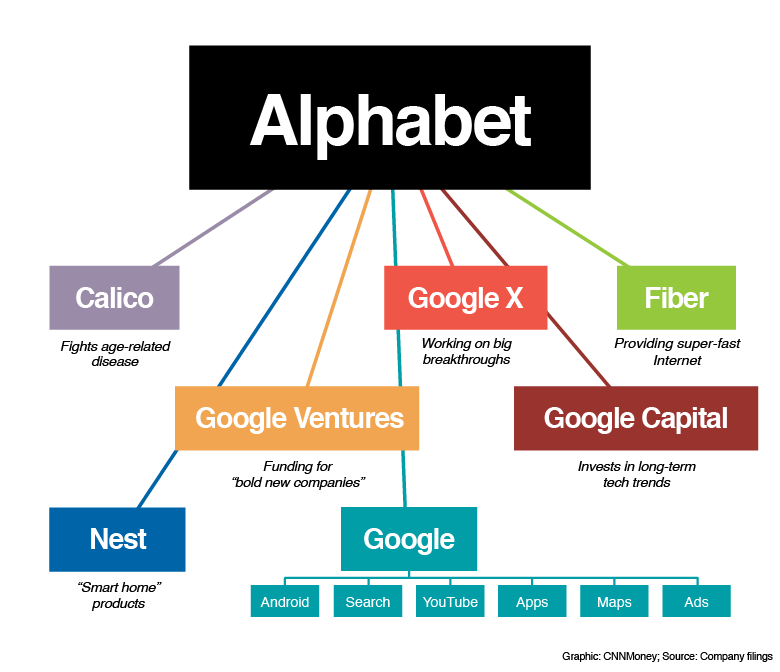
Google [stckqut]GOOG[/stckqut] announced a corporate restructuring on Monday, forming an umbrella company called Alphabet and naming a new CEO to the core business of Google.

Google co-founders Larry Page and Sergey Brin will run Alphabet — Page as CEO and Brin as president.

The company, which was founded in 1998 and went public in 2004, announced its new operating structure in a blog post on Monday called “G is for Google.”

They also said that Sundar Pichai is taking over as CEO of Google. Pichai has worked at Google since 2004, most recently as the senior vice president of product. Pichai has also been the most visible Google executive of late, giving the keynote at Google’s annual developers conference earlier this year.

Source: Meet Alphabet – Google’s new parent company – Aug. 10, 2015

  1. Federal Reserve and the Rate Hike Quagmire. By itself, a bump up in overnight lending rates may not be a big deal. Conversely, participants may perceive inaction (an unwillingness to do anything) or too much activity (back-to-back rate hikes on wishy-washy data) as a major policy mistake.
  2. Extremely High Valuations and Eroding Domestic Internals. High valuations alone can always move higher; excitement can turn to euphoria. Yet history has rarely been kind to the combination of stock overvaluation and narrowing leadership (i.e., bad breadth).
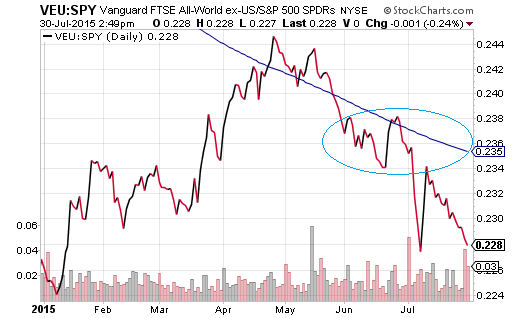
  3. Fading Effects Of Quantitative Easing/Other Stimulative Measures In Foreign Stocks. Both Europe and Japan had seen their prices surge shortly after confirmation of asset purchases. Over the last three months, those fortunes have cooled relative to the U.S. In some instances, as has been the case in China, stimulative measures that didn’t work eventually turned to direct (as opposed to indirect) market manipulation. Is the world losing faith in its central banks?
  4. The Return of Credit Risk Aversion In Bonds. Seven months into 2015 and the widely anticipated jump in 10-year yields is nowhere to be seen. In fact, the 10-year at 2.25% is roughly in the exact same place as it was when the year started. It has been lower (much lower); it has been higher, not far from 2.5%. Yet the bottom line is that treasuries via the iShares 7-10 Year Treasury Bond ETF (NYSEARCA:IEF) is rising in relative strength when compared with a high yield bond proxy like the iShares iBoxx $ High Yield Corporate Bond ETF (NYSEARCA:HYG).
  5. Economic Weakness in the U.S. and Across the Globe. Latin America, Asia, Europe. Name the region and the economic deterioration is palpable. In contrast, many portray the U.S. economy in a positive light. Headline unemployment is low, home prices are high and Q2 GDP at 2.3% is faster than what we witnessed in Q1. Yet labor force participation (employment) is at 1977 levels, home ownership is at the lowest levels since 1967 and GDP has grown at an anemic 2% over the last six years. That’s not what a recovery typically looks like. It is no wonder that revenue (sales) at U.S. corporations will be negative for the second consecutive quarter. And when both the quality of job growth as well as the weakness in revenues are tallied, nobody should be surprised at the snail’s pace of wage growth either (2%).

Source: 5 Reasons To Lower Your Allocation To Riskier Assets