Boomer retirement looks like it is being significantly impacted, according to this infographic. The expectation that each successive generation will be better off financially than the prior is no longer valid. Contributing to this new reality has been the diminishing role of traditional pension plans with defined benefits in favor of 401(k) savings plans.

It also appears that the recent recession has had a major negative impact to retirement savings. As the economy improves, it is hopeful this can be changed. Readers of this site should take extra steps to make sure they are significantly beating these averages.

Sources: Center for Retirement Research, Federal Reserve, U.S. Census Bureau, Fidelity Investments

GRAPHIC: DAVE MERRILL / BLOOMBERG VISUAL DATA
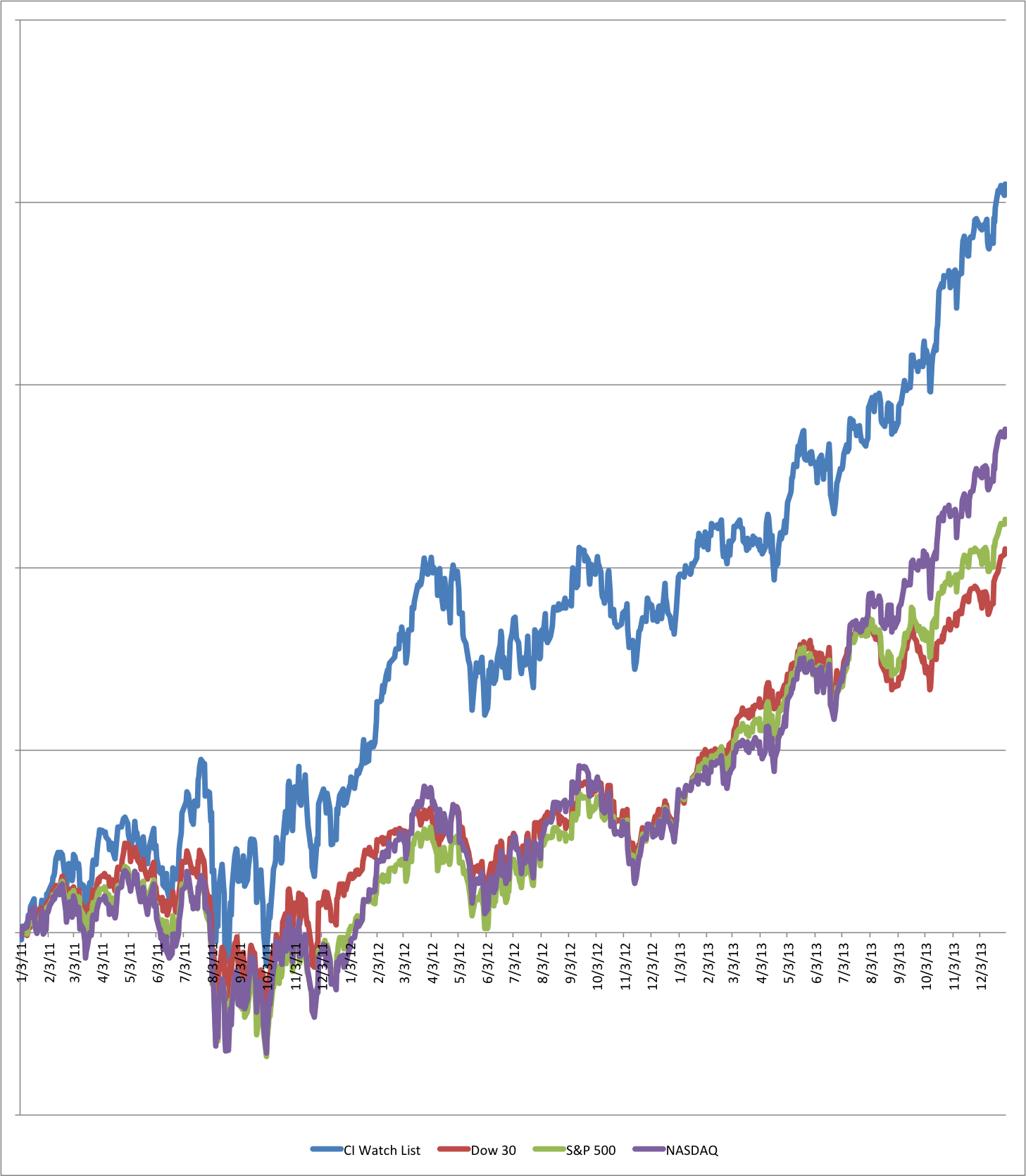
It is important for an active investor to know if he or she beat the stock market or if the system used is lagging a simple index fund. I am happy to report that over the past 3 years, my Watch List would have beat the stock market (e.g. the Dow Jones Industrial Average) by 95.2%. Several months ago, I reported my Watch List beat the stock market by 69% but that performance has been improved to 95.2%.

My book, The Confident Investor, is designed to help you grow a portfolio over time. It is designed for the investor that does not have enough money to fully diversify into enough quality stocks. The strategy uses an easy method to identify the time to invest an oversized share of your portfolio into certain stocks, allow that investment to grow quickly, and then rebalance to the next fast moving stock.

There are situations where an investor has saved money for a long time and has accumulated a comfortable sum in an investment account. In those situations, the investor may want to acquire shares in a diverse portfolio and have that money grow without active effort. Some would say that this is where mutual funds come to play, but the success of managed mutual funds is quite suspect. Index funds are always a good option, and I suggest that every investor have some exposure to index funds.

In the case of a mature investor with substantial savings to invest, I suggest that neither managed mutual funds nor index funds are appropriate. Rather, I suggest that the investor evenly divide the investment among high quality stocks such as my Watch List. As a test to this strategy, I compared the 3-year return of my Watch List to the major stock indicators. My Watch List achieved a 82.06% return over 3 years! This compares to the Dow Jones Industrial Average 3-year return of 42.04%, the 3-year S&P 500 return of 45.03%, and the 3-year NASDAQ return of 55.18%. This means I beat those indexes by 95.2%, 81.1%, and 48.7% respectively! This is a very sizable difference in return and can make a sizable impact in your longterm financial success.

3 year stock performance of Watch List

It is rare that someone has enough investment dollars saved up to invest evenly in this many stocks. If you have achieved that level of savings, then this may a simpler way to take advantage of this technique. The process is actually quite simple. Divide your money evenly among the 64 stocks that are on the Watch List. Every year, on the anniversary of beginning this technique, rebalance your investments evenly across the list. That is all that is required.

Other methods to beat the stock market

It may be easier to simply focus on the fastest growing stocks of this list.  I recommended 15 stocks at the beginning of 2014 that I felt would be an excellent portfolio. You can read that article here. Those selected 15 stocks beat the Dow Jones Industrial Average by 330.57%!

My traditional method of investing should be a higher return than this method. It requires more vigilance and effort. My traditional method has you tracking the performance of each stock several times a week. You will then invest a larger than normal amount of money into a couple fast moving stocks. When a stock cools down, you will leave the stock and invest your capital in another stock that is increasing rapidly. Think of it as always increasing the value of the stock and never decreasing it by taking advantage of all of the highs but none of the lows. This allows you to grow your investment fund so that you can achieve the steady state described here.

One of the elements of the traditional method that I teach is that you leave your profit with the stock that generated the profit. I call this system Grow on Other People’s Money. It essentially allows you to move your limited cash to the fastest growing stock and leave the profit that is generated in that stock. The profit that you leave in place is “free money” since you have already preserved your initial capital and invested it elsewhere. This strategy tends to have rapid increases in specific stock holdings but even the remaining profit will beat the market because you have invested in a great company.

My overall philosophy is simple. Find great companies that are so well run that it is easy to beat the market and invest in those companies with a plan.

I regularly update the Watch List. Every week I publish reviews of companies. Sometimes those companies are so good that I add them to my Watch List. You should follow my posts to get updates on great companies that I have found (and learn the companies that you should drop). You can make sure that you are receiving my updates by subscribing to me in several forums:

The companies that I used for this analysis (and my current Watch List as of this writing) were:

  • ABIOMED Inc.
  • Agilent Technologies Inc.
  • Akamai Technologies Inc.
  • Alexion Pharmaceuticals Inc.
  • Alliance Data Systems Corporation
  • American Tower Corporation
  • Analog Devices Inc.
  • ANSYS Inc.
  • Ascena Retail Group Inc
  • Atlas Pipeline Partners L.P.
  • Balchem Corporation
  • BlackRock Inc.
  • Broadcom Corporation
  • Baytex Energy Corp
  • Compania de Minas Buenaventura SA (ADR)
  • Buffalo Wild Wings
  • Chicago Bridge & Iron Company N.V.
  • Cerner Corporation
  • Capital One Financial Corp.
  • Cirrus Logic Inc.
  • Cummins Inc.
  • Darling International Inc.
  • Deckers Outdoor Corporation
  • eBay Inc.
  • Equinix Inc
  • Extra Space Storage Inc.
  • First Financial Bancorp
  • Fossil Inc.
  • Goldcorp Inc.
  • Google Inc.
  • Gulfport Energy Corporation
  • Herbalife Ltd.
  • HMS Holdings Corp.
  • Harley-Davidson Inc.
  • Helmerich & Payne Inc.
  • IBERIABANK Corporation
  • Intuitive Surgical Inc.
  • JPMorgan Chase & Co.
  • KLA-Tencor Corporation
  • Liberty Property Trust
  • Monster Beverage Corp
  • Merck & Co. Inc.
  • Nordson Corporation
  • Net Servicos de Comunicacao SA (ADR)
  • Annaly Capital Management Inc.
  • Nexstar Broadcasting Group Inc.
  • priceline.com Incorporated
  • Panera Bread Company
  • Potash Corp.
  • QUALCOMM Inc
  • Questcor Pharmaceuticals Inc
  • Royal Gold Inc.
  • The Boston Beer Company Inc.
  • Skyworks Solutions Inc
  • Titan Machinery Inc.
  • Thermo Fisher Scientific Inc.
  • Trimble Navigation Limited
  • Tractor Supply Company
  • Under Armour Inc.
  • Ulta Salon Cosmetics & Fragrance Inc.
  • Ultratech Inc.
  • Vale
  • Washington Banking Company
  • Yum! Brands Inc.

You can find my updated Watch List on the right side of this site as well as reproduced on this page.

If you want to learn more about how I find great companies, read my book. You can purchase my book wherever books are sold such as AmazonBarnes and Noble, and Books A Million. It is available in e-book formats for NookKindle, and iPad.


Strategy

successful investment strategy

An example of this successful investment strategy will help you better understand. You buy 100 shares of a company at $40. It costs $10 in stock broker commission, so you spent $4010. Over the course of a few months, the stock rises to $44. Your investment is now worth $4400. The indicators make you believe that this company will have a short term pullback in its stock price, so you want to sit back while the market moves. However, you still want your money to work for you at this great company. You sell your initial investment only ($4,010) plus the selling commission of $10. $4020 divided by $44 means 92 shares (or a net of $4,048). Your principle is safe (plus the $28) and you have 8 shares in this great company. These 8 shares were bought with Other People’s Money.

Eventually, the indicators show that you should buy in again. Perhaps this new level is $43. You reinvest your $4,048 minus $10 commission and buy 93 shares with $39 left over. You now own 101 shares for your original $4,000 investment for an average price of $39.60. You have bought these shares at a discount of $4.40 per share. In addition, you have $39 in your money-market account at the broker making money at market rate interest.

Using this technique as part of a successful investment strategy on a great company, slowly over time, your investment will grow. Your downside risk will be minimized (although with all investing, your risk is never minimized to zero).

Typically, I do not use technical trading tools to sell the shares that I buy on Other People’s Money. I only sell those shares when the fundamentals of the company start to turn from Fair to Poor or when the stock has appreciated to the point that I see little upside. Otherwise, these are lifetime investments because I have not spent any money to acquire them.

I cannot leave this subject a successful investment strategy without a reminder for you to be cautious with your earnings. Try to avoid greed and hope for a small return on your money. When you are concerned that the market has moved against you and the indicators all look like they are going to give you a sell signal soon, go ahead and lock in your profit. There is no shame in being cautious and profitable as you work your successful investment strategy.

Image courtesy of Stuart Miles at FreeDigitalPhotos.net

ID-100142022An effective stock investment strategy comes with the realization that a small profit is better than a small loss!

Always remember this as you manage your portfolio. Also, remember you will not go broke if you lock in your profit at a lower level while the price of the stock continues to go up. While you will not achieve additional gains, it is far better to lock in your profit than hold it too long and take a loss. The amount of profit that you need is a personal decision. Do not be ashamed to lock in a profit when you feel that your downside risk is greater than your upside potential.

Elsewhere on this site, I have told you that buying a stock and just holding it forever was probably not a wise strategy. The problem with this “Buy and Hold” strategy is that you weather all the bad times while trying to take advantage of the good times. If the stock stays flat over the course of a year after growing 10% the previous year, you only make 5% over 2 years, and that is probably not robust enough. Inflation takes a 2-3% bite out of your spending power so over 2 years you lose 4-6%. You probably lost money on that stock investment or at least minimized its ability to increase your wealth.

You should evaluate your stock investment holdings regularly to see if you would buy the stock again given the information that you have today. While the stock may have been the right thing to buy yesterday (or last week/month/year), is it the right one to buy today? At a minimum, you should check your Fair companies that you invested in to make sure that they are not Poor companies now. Also, every company that you invest in should be profitable for the latest fiscal quarter and the latest fiscal year. You cannot confidently invest in a company that is not profitable.

This constant re-evaluation is necessary simply because there are other investments for your money. When one stock investment is flat, another company may do remarkably well. For nearly every economic period, there are companies that struggle and others that prosper. You do not need to keep your stock investment in companies that struggle. They can struggle without you. Put your stock investment money in companies that take advantage of the current economic climate.

Image courtesy of Stuart Miles at FreeDigitalPhotos.net

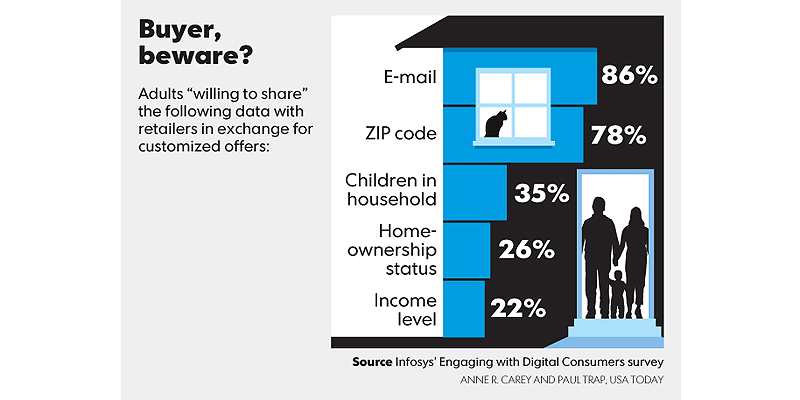
I thought this was an interesting (albeit small) infographic.  How much personal information would you be willing to share to increase your discount?


I would share certain personal information. If I knew that I would do business again with the company, then I would be much more generous than if I thought I was not going to return. If I was not returning, then I would share bogus information and give out my email address that I reserve for getting spam.  A more trusted retailer would get my personal email and more data about me.

I saw this image on a Twitter post from the USAToday.