This is not an Apple [stckqut]AAPL[/stckqut] fanatics site but the importance of the iPhone to the technology world and the market in general is rare. There are few products, that if turned into standalone companies, would be as significant as the iPhone.

As an example, if the iPhone was a standalone company it would have revenue of $88.4B. This means that it would rank 28th on the Fortune 500 and would be between Archer Daniels Midland [stckqut]ADM[/stckqut] and Procter & Gamble [stckqut]PG[/stckqut]. In fact, if Apple spun off the iPhone, Apple would drop to 30 or 31 on the list from its current 6th place and iPhone Inc. would be larger.

BusinessWeek points out that the new company, iPhone Inc., would be the 9th largest company on the Dow Jones Industrial Average.
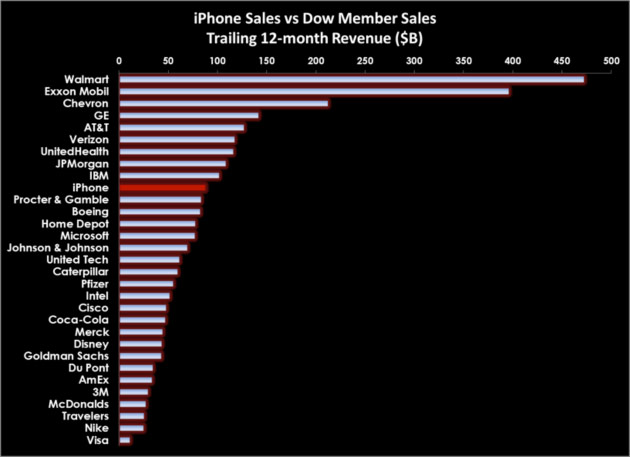
iphone_vs_dow

It is an unfortunate reality for workers of the 21st century that life is different from their parents. Your parents were undoubtedly hard workers and worried about their future, so I do not want to dismiss their efforts. However, for many workers today, planning for retirement requires more work than our parents put into the subject.

I am likely to make a few generalizations in this document. Your individual situation may vary, but in general, the young workers of the 1960s and 1970s had a few benefits that are not enjoyed today.

  • Many companies then had pensions. Today, few companies have pensions and only offer 401K savings plans that are moderately contributed to by the employer
  • Social Security was a fairly safe security net. The workers of the 60s and 70s had the population numbers working for them so Social Security was going to be funded for much of their lives. The prudent worker of 30 years ago realized Social Security would not cover 100% of future living expenses, but there was little fear of it being defunded.
  • Life expectancy was not as long. It was fairly uncommon to have a relative past 80 and definitely 90 years of age – the norm was closer to mid-70s. Therefore, financial planning really only need to cover until about 75-80 years of age. Now, many people know 90 year old relatives or friends that are incredibly active. The assumption is that you will live to be 90.

Life today is different. Today we rarely have pensions from our employers. Social Security is not a sure bet that it has a viable future. In addition, we are living longer.

I don’t want to seem like life was better in the past than it is today. I’m actually fairly optimistic about the prospects of living in the second decade of the 21st century. I believe that we have more opportunities today than our predecessors. I also believe that we live more comfortably than previous generations of Americans.

Unfortunately, we do need to spend more time worrying about our financial future than our parents ever had to do. This concern and planning is not a big drag on our lives, but it is an important element of living in today’s economy.

This is why I wrote my book The Confident Investor.” Today’s workers need to focus on developing the portfolio of investments that will allow them to live comfortably until they are 90-100 years old. You cannot expect Social Security or your employers pension to keep you comfortable after you stop working.

Building a portfolio that will make you financially comfortable is not extremely difficult. It does require some effort on your part. It’s also requires you to pre-plan how you spend and save your money. It is critical that you are not like the ostrich that hides its head in the sand, but instead plans ahead for retirement when you are not working.

A worker in today’s economy needs to save diligently and invest aggressively so that you can retire in luxury. This site, combined with my book The Confident Investor,” will help you invest in the stock market to attain a comfortable and luxurious retirement.

As always, you are welcome to correspond with me personally on this site, on Twitter, or on Facebook. I look forward to helping you develop a portfolio that exceeds the retirement of your parents and your grandparents. Your life and your future are in your control. Now is the time to start the process of preparing for the rest of your life.

You can purchase my book wherever books are sold such as AmazonBarnes and Noble, and Books A Million. It is available in e-book formats for NookKindle, and iPad.

Many investors claim they don’t subscribe to any tenet of technical analysis. Frankly, I have rarely seen a successful investor that doesn’t do a bit of simple technical analysis.

If technical analysis is so terrible, why do so many investors pay attention to the 52 week high or low? Even this thought pattern is a basic form of technical analysis. Basically, you are making a decision based on a past action of the stock. A better name for technical analysis would be chart analysis since it is the use of charts to make investment decisions. It is trying to interpret market psychology based on the past actions of that market. At its core, technical analysis is simply a method of determining if a stock is worth buying or selling.

Technical analysis is simply the study of market generated data. This includes price levels that have served as past turning points, the amounts of stock being bought and sold each day (volume), and the rate of change of price movements (momentum) over a given span of time.

Fundamental analysis, which seeks to uncover the true value of a stock, depends on future sales, earnings, and cost estimates of a company. Often, these numbers change as outside influences, such as the overall economy or the company’s competitive landscape, change. The basics of technical analysis i.e. the price of shares and the volume being sold, never change.

Technical analysis isn’t magic. It won’t guarantee a great buy or a great sell. But chart analysis can help make a decision to buy, sell or hold. These decisions are based on the probabilities of the actions of others. If a pattern on the chart appears, a chart watcher can react to that pattern. It does not work every time, but past performance does give us an idea of what will happen so we can do something about it.

Consumer Queen is a great site for getting practical advice on life. I really enjoyed one of their articles on saving money and thought I would share it with you. Here are the highlights they list:

  1. Make a pledge with your spouse
  2. Say no to charging
  3. Plan for the future
  4. Couponing
  5. Clean out the Clutter
  6. Pay Attention to you Bank Account
  7. Cut It Out
  8. Give Yourself an Allowance
  9. Don’t Impulse Buy
  10. Make Wise Decisions

Jump over to Consumer Queen and read their advice on each step. I think it will be worth your time.

There is nothing that will destroy your ability to save money for the future and invest in your own welfare like living beyond your means. I am often told by my readers (by email, Facebook, or Twitter) that they cannot afford to invest because they cannot even live on their own paycheck.

Far be it for me to tell someone else how to live and the personal decisions that individual or family has to make. I did read this article recently that impressed me for the frugality of these super-rich people. These people are not just rich; several of them are the 1% of the 1%. While I am sure there are certain aspects of their individual lives that we may deem excessive, it is important for all of us to do whatever is reasonable to reduce our daily costs of living. If you invest that savings, you have the potential for financial independence some day.

  • Legendary US investor Warren Buffett, who has an estimated net worth of $US54.6 billion, famously still lives in the same five bedroom house he bought 55 years ago for $US31,500.
  • Chuck Feeney, co-founder of Duty Free Shoppers who has donated his fortune of more than $US6 billion to charity, travels in economy class “because first class won’t get me to my destination any faster”. He doesn’t own a house or a car and wears a $15 watch.
  • Ikea founder Ingvar Kamprad also prefers to fly economy class, and prefers to book with budget airlines. He also encourages his Ikea staff not to be wasteful, and tells people off if they don’t use both sides of a sheet of paper or leave lights on when they leave a room.
  • US oil magnate T. Boone Pickens, worth $US1.2 billion, reportedly shops with a grocery list and only carries enough cash in his wallet to cover what he is about to buy for better budgeting.
  • Indian mogul Azim Premji, worth an estimated $US11.2 billion, drove a Ford Escape for eight years before he traded it with a Toyota Corolla. When he travels he prefers budget hotels over five-star accommodation.