Over the last several weeks, I have been re-checking the Watch List that I maintain on this site. This is an essential exercise that I do on a regular basis, and you should do as well. You need to ask yourself if the stocks that you have currently selected to be in your portfolio are still high enough quality to be in your portfolio. If you followed along, you know that I took several stocks off of my Watch List.

My book, The Confident Investor, is designed to help you grow a portfolio over time. It is designed for the investor that does not have enough money to fully diversify into enough quality stocks. The strategy uses an easy method to identify the time to invest an oversized share of your portfolio into certain stocks, allow that investment to grow quickly, and then rebalance to the next fast moving stock.

There are situations where an investor has saved money for a long time and has accumulated a comfortable sum in an investment account. In those situations, the investor may want to acquire shares in a diverse portfolio and have that money grow without active effort. Some would say that this is where mutual funds come to play, but the success of managed mutual funds is quite suspect. Index funds are always a good option, and I suggest that every investor have some exposure to index funds.

In the case of a mature investor with substantial savings to invest, I suggest that neither managed mutual funds nor index funds are appropriate. Rather, I suggest that the investor evenly divide the investment among high quality stocks such as my Watch List. As a test to this strategy, I compared the 3-year return of my Watch List to the major stock indicators. My Watch List achieved a 90.01% return over 3 years! This compares to the Dow Jones Industrial Average 3-year return of 53.19%, the 3-year S&P 500 return of 56.35%, and the 3-year NASDAQ return of 61.95%. This means I beat those indexes by 69.21%, 59.73%, and 45.28% respectively! This is a very sizable difference in return and can make a sizable impact in your longterm financial success.
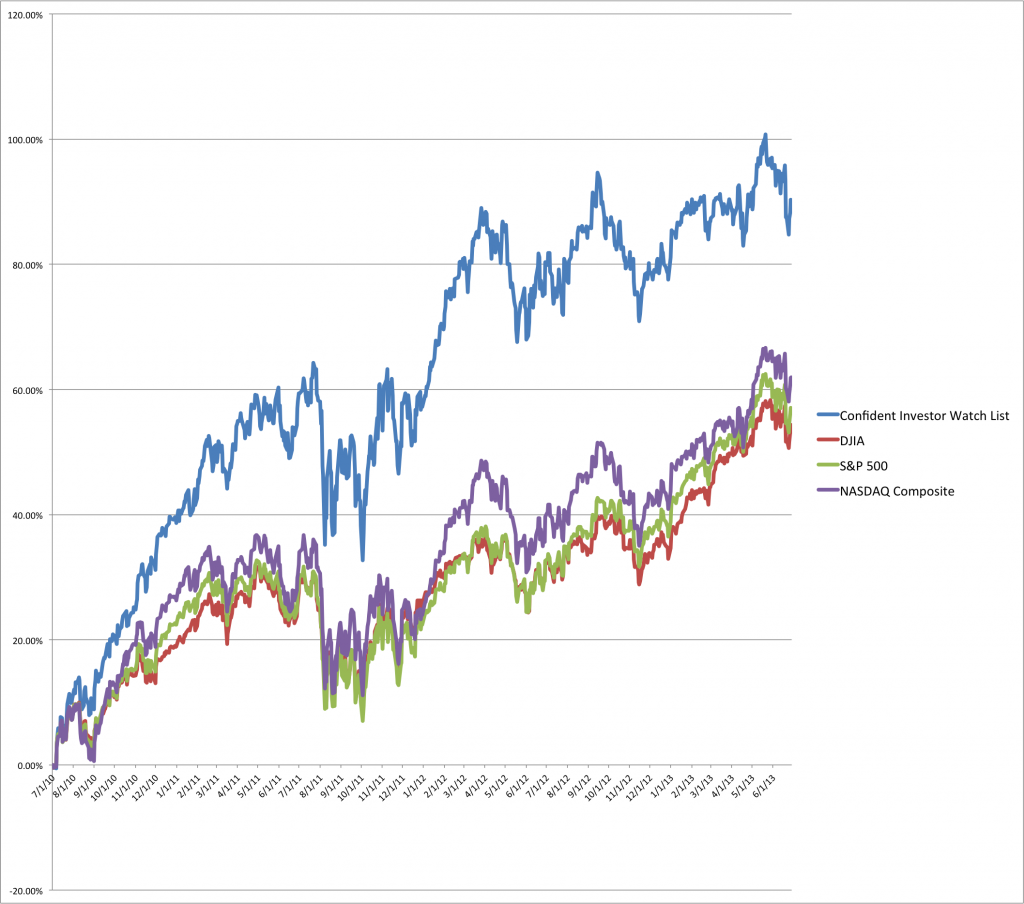
Watch List Performance

It is rare that someone has enough investment dollars saved up to invest evenly in this many stocks. If you have achieved that level of savings, then this may a simpler way to take advantage of this technique. The process is actually quite simple. Divide your money evenly among the 51 stocks that are on the Watch List. Every year, on the anniversary of beginning this technique, rebalance your investments evenly across the list. That is all that is required.

My traditional method of investing should be a higher return than this method. It requires more vigilance and effort. My traditional method has you tracking the performance of each stock several times a week. You will then invest a larger than normal amount of money into a couple fast moving stocks. When a stock cools down, you will leave the stock and invest your capital in another stock that is increasing rapidly. Think of it as always increasing the value of the stock and never decreasing it by taking advantage of all of the highs but none of the lows. This allows you to grow your investment fund so that you can achieve the steady state described here.

One of the elements of the traditional method that I teach is that you leave your profit with the stock that generated the profit. I call this system Grow on Other People’s Money. It essentially allows you to move your limited cash to the fastest growing stock and leave the profit that is generated in that stock. The profit that you leave in place is “free money” since you have already preserved your initial capital and invested it elsewhere. This strategy tends to have rapid increases in specific stock holdings but even the remaining profit will beat the market because you have invested in a great company.

My overall philosophy is simple. Find great companies that are so well run that it is easy to beat the market and invest in those companies with a plan.

I regularly update the Watch List. Every week I publish reviews of companies. Sometimes those companies are so good that I add them to my Watch List. You should follow my posts to get updates on great companies that I have found (and learn the companies that you should drop). You can make sure that you are receiving my updates by subscribing to me in several forums:

The companies that I used for this analysis (and my current Watch List as of this writing) were:

  • Agilent Technologies Inc.
  • Apple Inc.
  • Akamai Technologies Inc.
  • Alexion Pharmaceuticals Inc.
  • American Tower Company
  • ANSYS, Inc.
  • Atlas Pipeline Partners
  • Ascena Retail Group Inc.
  • Balchem Corporation
  • Blackrock, Inc.
  • Broadcom Corporation
  • Baytex Energy Corp
  • Compania de Minas Buenaventura SA (ADR)
  • Buffalo Wild Wing
  • Capital One Financial Corp
  • Cirrus Logic, Inc.
  • Cummins Inc.
  • Darling International Inc.
  • Deckers Outdoor Corporation
  • Ebay Inc.
  • Equinix, Inc.
  • Extra Space Storage
  • First Financial Bancorp
  • Fossil, Inc
  • Goldcorp Inc.
  • Google Inc.
  • Herbalife Ltd.
  • HMS Holdings Corp
  • Harley-Davidson, Inc.
  • Helmerich & Payne Inc.
  • IBERIABANK Corpor
  • Intuitive Surgical Inc.
  • JPMorgan Chase & Co.
  • KLA-Tencor Corporation
  • Liberty Property Trust
  • Monster Beverage
  • Merck & Company
  • Net Servicos de Comunicacao SA (ADR)
  • Annaly Capital Management Co.
  • Priceline.com Inc
  • Potash Corporation
  • QUALCOMM Incorporated
  • Questcor Pharmaceuticals
  • Royal Gold, Inc.
  • The Boston Beer Company
  • Skyworks Solutions Inc.
  • Tractor Supply Co
  • VALE S.A.
  • Volterra Semiconductor Corporation
  • Washington Banking
  • Yum! Brands, Inc.

You can find my updated Watch List on the right side of this site as well as reproduced on this page.

If you want to learn more about how I find great companies, read my book. You can purchase my book wherever books are sold such as AmazonBarnes and Noble, and Books A Million. It is available in e-book formats for NookKindle, and iPad.


stockup

As you look at company metrics, it is necessary to remember that a company will rarely be perfectly consistent. Company results will vary due to a variety of situations, some of which will be outside of company control. For instance, a general increase in the price of gasoline can affect many companies for the positive or the negative.

These market adjustments are extremely difficult for company managers to adapt to rapidly and may force them to grow too quickly, face unforeseen costs, or see a contraction in their core markets. Over the course of a few months, most companies will start to accommodate the new market situations and be back on track; however, that peak or dip may disrupt the metrics for any given quarter.

Because of these incidental disruptions in business, a Confident Investor will not spend too much time digging into a company’s quarterly releases. Instead, focus on the annual numbers. Quarterly statements are more for the sake of allowing you to understand if there has been some significant change in the company’s core business, as opposed to a short-term disruption.

It is vital to look at the changes from year to year and over time. These changes will indicate if the company takes advantage of market situations and weathers bad times well. You thus need to understand how to analyze growth over time and decide if it is acceptable.

The simplest method of averaging these values is to take the last 5 or 10 years of results and calculate the average. Unfortunately, this can give a slightly distorted picture of the current performance of the company. To understand, let’s look at the sales revenue of a fictional company: Acme Widgets, Inc. ACME has the following sales revenue (all numbers below are in millions of dollars).

Year

Revenue

% increase from previous year

10

 $ 600 3.4%

9

 $ 580 3.6%

8

 $ 560 3.7%

7

 $ 540 3.8%

6

 $ 520 4.0%

5

 $ 500 25.0%

4

 $ 400 33.3%

3

 $ 300 50.0%

2

 $ 200 33.3%

1

 $ 150


You could gather the first two columns from a variety of sources. The third column is the revenue increase for that year compared to the immediately preceding year. Most third party sites do not provide this information, so you will need to calculate it.

To calculate the third column, simply take the year’s metric, subtract it from the previous year, and divide that amount by the previous year. In the case of 2001, subtract $200M from $150M, which is $50M. If you divide $50M by $150M, the result is a 33.3% increase. If you are a registered owner of my book, The Confident Investor, you can download a worksheet that will help you with this effort by going to http://www.Confident-Investor.com/analysis-worksheet. You will need to be a registered user to access this page but you can register easily and for free by following the instructions.

A casual look at the revenue of ACME shows that they are growing their revenue, but the growth rate has slowed down fairly rapidly. However, if you do the simple calculation as to what percent increase it would take to grow $150M to $600M in 10 years, you would calculate this to be 13.9% per year if compounded continuously. A 13.9% increase year-over-year is great; but that is not occurring in this instance. ACME has not been close to that number for a few years.

You could average the annual rates by adding them up and dividing by 9. This would result in 12.8%. This is not indicative of what you would think of a company that has grown less than 4% for the past few years.

You could also perform a linear regression analysis of the growth rate. Linear regression is a moderately advanced mathematical method of fitting a straight line to a data set. It is easy to compute the linear regression in today’s modern spreadsheets but very complicated to do on paper or in your head. I don’t suggest that investors use linear regression as there is an easier method.

You do not want to focus on the last two to four years, since another company might have exactly the opposite circumstances. Another company could have had relatively flat increases for many years and then just recently hit a significant expansion of business. While you want to reward the recent increase (as it will likely continue to the immediate future), you also want to take in account that the company was flat in the past.

To accomplish this, you need to weight the averages over the years. The more recent years are more influential than the middle years which, in turn, are more influential than the later years. To solve this problem, I created the Decennary Time Weighted Average (DTWA). To learn about DTWA, please read my book as it is well explained in its pages.   You can purchase my book wherever books are sold such as AmazonBarnes and Noble, and Books A Million. It is available in e-book formats for NookKindle, and iPad.

Stock source from OpenClipart.

You might wonder if your credit cards could be used as an emergency fund.

Unfortunately, the answer is not clear cut, but it depends on your immediate situation. Basically, if you need a loan to cover your needs,  you should avoid the loan. If you don’t need a loan, then the loan is probably a decent thing.

Remember, your credit card is nothing more than a short-term loan for the balance of the month until your next bill. It is when you start to use short term credit card loans for a long time that you begin to have problems.

Too many people are already in credit card debt. This is likely costing them a great deal of income in interest. That interest is taking away from their ability to invest for the future.

If you carry a credit card balance,  adding an emergency charge will not help your situation in the long run.  You can do some substantial damage to your finances and your credit score.  You’ll probably end up paying interest on the charges, and you’re credit score will be hurt since you’re using more of your available credit.

On the other hand, if you have an emergency fund put away and you pay your credit card balances in full every month then using your credit card in an emergency is just a short-term bridge loan with no interest.  You can use the card then pay it off in full with your emergency savings.

Taking on additional debt to get you out of an emergency situation is not optimal. I understand if you must do it to get yourself out of a bad situation as that is the reason for the emergency fund. It is far better if you start today to build your emergency fund so that your credit card is simply a 30-day interest free loan.

If you thought this article was worthwhile, please tell your friends on Twitter about it by clicking here.

Editor’s Note: Dealing with current debt is a reality for many people. The challenge is to eliminate debt and at the same time grow your personal investment portfolio. Alanna does a great job of dealing with this issue.

In May of this year, the Federal Reserve Bank of New York reported that U.S. consumer debt totaled $11.23 trillion. If you are examining your personal financial situation to handle your share of this debt, you are taking the right step.

Managing your income properly requires an approach that is threefold, as you must look at what you owe today, how emergencies can impact your life and what you will be able to invest in to achieve retirement goals.

1. Handle high interest debt immediately. Credit card debt or loans with high interest rates have a tendency to drain even a solid income. Ignoring these debts or taking a haphazard approach to on-time payments can allow the problem to worsen, costing you more and more in interest and late fees. Start by making minimum payments on all the accounts you owe to put the accounts in good standing, which can eventually help your credit score improve.

There are two main schools of thought on which debts to pay off first, but there is a principle we can glean from both of them. One recommends paying off the account with the lowest balance first, which can seem easier and decreases the amount of open negative accounts. The other recommends paying off the account with the higher interest rate first.

Both of these strategies improve debt management as they approach debts by focusing on a specific problem and making an effort to pay more than the minimum payment on an account.

2. Put Together An Emergency Fund

Having savings for retirement is a goal to work toward after you have made a dent in your debt. Right now though, build up an emergency savings account of at least 3 months of after tax income. Your intention is to get out of debt and stay out of debt, so you need a cushion to soften any unexpected financial crisis.

Vehicles may suddenly require expensive maintenance. Costly medical issues can disrupt your life out of nowhere. You may encounter periods of unemployment or face increasing monthly rental payments. Being able to turn to an emergency fund in any of these situations can keep you from relying on credit or having to skip making your monthly loan payments.

3. Profit from Your Discretionary Income

Your discretionary income consists of the money you have after basic living expenses are subtracted based on the poverty line. What this means is taking your paycheck, subtracting regular necessary costs, then looking at what remains.

Once you have accomplished the goals of regularly paying on debts (including paying more on at least on accounts) and building an emergency account, you can pursue investing in any extra money from your discretionary income into savings.

You can begin with a traditional savings account that will earn a percentage on the money you deposit into it and also see what programs your job has to offer. There may be a 401(k) or other type of retirement account that will increase at a more rapid rate than your bank offers.

Research all of these options, while realistically considering how much you will be able to consistently set aside every paycheck.

Alanna Ritchie is a content writer for Debt.org, where she writes about personal finance and little smart ways to spend (and save) money. Alanna has an English degree from Rollins College.

Nothing is more valuable for eliminating a company from consideration than your feelings about the company and/or it operations or products. You may choose to not own a company if it interferes with your personal, religious, or moral goals. Some people will have problems with companies such as:

  • Alcohol manufacturers and distributors.
  • Military and munitions manufacturers.
  • Tobacco manufacturers and distributors.
  • Companies that may have operations with low employment standards.
  • Companies that support or do not support unionization.

Your personal feelings about a company should never be the primary reason to buy a stock. Just because you like a product or a service doesn’t mean you should invest your life’s savings in the company. Following those impulses can frequently destroy your portfolio.

It is reasonable, however, not to buy the stock of a company to which you have philosophical objections. Don’t make money from an operation that you do not think follows your personal convictions.