Historical test of $SAM results in 27.0% increase in profit
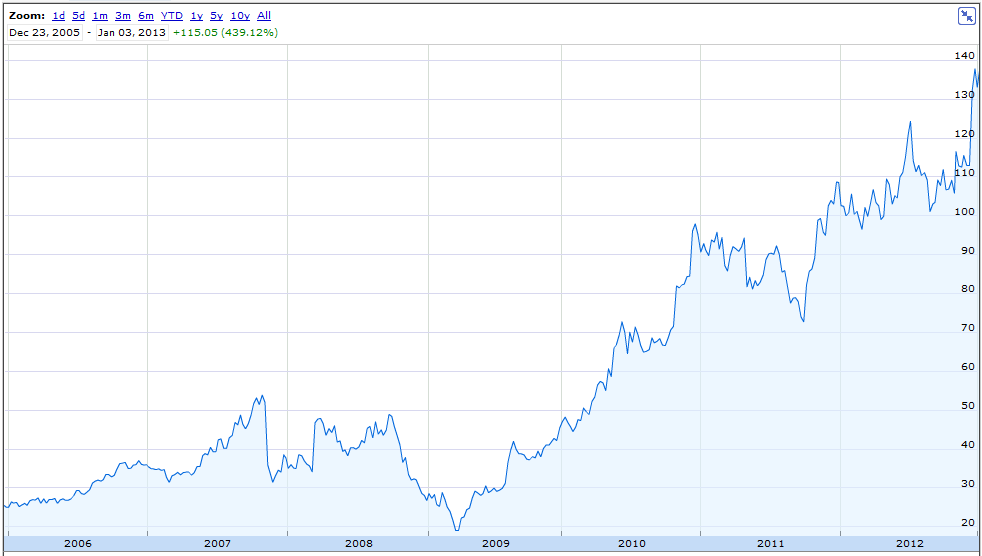
In a 7 year time frame from January 3, 2006 to December 31, 2012, Boston Beer [stckqut]SAM[/stckqut] increased 433.4% if you would have implemented a pure buy-and-hold strategy. If you would implemented the strategy that I explain in my book, The Confident Investor, you would have seen a 550.6% return on your investment. This is a 27.0% increase on the profit percentage.
To put it into actual dollars, suppose you invested $10,000 in SAM on 1/3/2006. With the system that is explained in The Confident Investor, you would have exited the market on 12/31/2012 with $77,006.32. With my system, it is not uncommon for you to need a bit more cash available to cover the ongoing trades. Therefore, rather than $10,000, you would have needed $11,836.98. You would have 502 shares which were purchased with other people’s money and still have your original $10,000.
To be fair in our comparison, the buy-and-hold method if calculated with $11,836.98 would have ended up with $63,136.04 and a respectable 433.4%. You would have purchased 473 shares but your original $11,836.98 would be tied up in the stock.
The profit on the buy-and-hold strategy in this scenario is $51,299.72. The profit using GOPM (Grow on Other People’s Money) is $65,170.64. That means the increased profit on SAM in this time frame was $13,870.92. This means your profit INCREASED by 27.0%!!
Understanding buy-and-hold is easy. You have a given amount of money, in this case $11,836.98. You buy 473 shares at the start of the test period. At the end of the test period, you sell the shares and the profit (or loss) is the standard that any other system must beat.
Understanding GOPM is a bit more complicated without reading my book, The Confident Investor. Before you even start to invest, the system teaches you to look for incredibly well-run companies and only invest in those companies. While SAM may or may not have qualified for this status in 2006, it does in 2013 so we are simply back-testing against a currently well-run company. While past performance doesn’t guarantee future performance, it is probably the best tool that we have to understand investment methodologies.
After you find a well-run company, you are going to buy $10,000 worth of shares when the technical indicators tell you that the stock has upward momentum. You are then going to sell those shares when that momentum slows down or reverses. The profit that you make on that transaction, you will keep in the stock (in other words, you are not going to sell those shares). You are going to keep the $10,000 ready for when the stock has the correct momentum. If there is any excess profit (e.g. less than the value of a full share after keeping the $10,000) you will just stick that into your money-market account in this example. It is possible that you could invest this excess amount but we are going to simplify this example and just hold that money.
As a quick example, you invest $10,000 in a stock trading at $50 per share so you have purchased 200 shares. Over the course of the next several days or weeks, the stock price increases to $55 which is where you decide to sell. To get your original capital of $10,000 back, you sell 182 shares resulting in $10,010 in your account and 18 shares that are essentially free since they were purchased with Other People’s Money. You now have your original capital of $10,000, 18 free shares and an additional $10.
Using this technique, you will make several trades per year and may even be trading weekly. Therefore, to make this model fair, I need to account for stockbroker fees and commissions. In this example, I am using $8 for every sell and for every purchase. You may have a better fee from your favorite broker but $8 seems fair for a test. Frankly, if you are paying more than $10 for each transaction then you probably need to be looking at another broker!
Using this technique, by the end of the test on 12/31/2012 you would have 502 shares of SAM that cost you $1,836.32. Those 502 shares were acquired for $3.658 per share! This is significantly cheaper than today’s stock price and no matter what happens to SAM you could probably sell these shares for a profit at any time! You would still have the original $10,000 in your bank account! This is because you have purchased these share with Other People’s Money. This is why I call my system GOPM – Grow on Other People’s Money.
If you would have invested in Boston Beer as described in this article, you would have doubled your investment by August 14, 2009. By that date, you would have acquired 255 shares of SAM which were valued at about $39.78 for a total profit of $10,142.63. This means your $10,000 initial investment would have doubled.
The rest of this article shows each buy and sell transaction for those 7 years. It shows the date, the assumed purchase price on that day (taken from Yahoo – the purchase price is the average of the opening and closing price on that day) and the profit or loss. If you haven’t read my book, The Confident Investor, then you may not understand the timing of the trades. In fact, if you haven’t purchased the book and registered here on this site as a book owner then you won’t be able to see those individual trades. If you have registered and cannot see the trades, make sure you are logged in and refresh your browser.
Which brings me to the big set of questions. Shouldn’t you own this book? Does your investment strategy beat buy-and-hold? Do you even have an investment strategy? If your strategy beats buy-and-hold, does it beat GOPM – Growing on Other People’s Money?
You can purchase my book wherever books are sold such as Amazon, Barnes and Noble, and Books A Million. It is available in ebook formats for Nook, Kindle, and iPad. It may be available at your favorite bookstore as well but you may have to ask.
SAM 6 year chart from Google Finance
[s2If current_user_can(s2member_level1)]
Description of SAM trades table
While it may be obvious the meaning of the various columns, some of them definitely need a bit of explanation if you have never walked through a trading analysis with me.
Date – The date of the trade. It is important to note the long delays between trades. This will help you with your portfolio since you do not have to dedicate your average trade purchase (in this case $10,000) to just one stock but rather you can invest that money in the hottest stock at the time.
Buy/Sell – This is probably pretty obvious. On this date, did the system buy or sell the stock? The SELL will only sell from the previous transaction’s BUY.
Purch. Price – The selling or buying price of this transaction. This is taken from Yahoo’s Historical Pricing page and it is the average of the opening and closing price on that day.
Shares purchased – The number of shares that $10,000 will buy on that day.
Invested – The amount that was actually purchased. This is the number of shares (the previous column) multiplied by the Purch. Price column.
Returned – When you sell the shares from the previous BUY, the amount of money that results.
Profit/Loss – How much was profited from the previous BUY.
Free shares – If the SELL was profitable, how many shares was evenly divides into this profit. These are free shares as they were purchased with Other People’s Money.
Excess – After the Free Shares are taken out, how much money is left over. If the transaction was not profitable, then what was the loss.
Running investment balance – A running total of the value of the investment.
SAM trades table
| Date | Action | Purchase price | Shares purchased | Invested | Returned | Profit / Loss | Free shares | Excess | Running investment balance |
| 01/19/06 | BUY | 26.055 | 383 | 9979.065 | 0 | ||||
| 01/25/06 | SELL | 26.03 | 9961.49 | -17.575 | -17.575 | -17.575 | |||
| 02/15/06 | BUY | 26.12 | 382 | 9977.84 | -17.575 | ||||
| 02/22/06 | SELL | 25.875 | 9876.25 | -101.59 | -101.59 | -119.165 | |||
| 02/27/06 | BUY | 25.93 | 385 | 9983.05 | -119.165 | ||||
| 03/06/06 | SELL | 26.275 | 10107.875 | 124.825 | 4 | 19.725 | -99.44 | ||
| 03/08/06 | BUY | 26.525 | 376 | 9973.4 | -99.44 | ||||
| 03/16/06 | SELL | 26.935 | 10119.56 | 146.16 | 5 | 11.485 | -87.955 | ||
| 03/23/06 | BUY | 27.205 | 367 | 9984.235 | -87.955 | ||||
| 03/27/06 | SELL | 26.905 | 9866.135 | -118.1 | -118.1 | -206.055 | |||
| 04/05/06 | BUY | 27.23 | 366 | 9966.18 | -206.055 | ||||
| 04/10/06 | SELL | 26.92 | 9844.72 | -121.46 | -121.46 | -327.515 | |||
| 04/19/06 | BUY | 27.27 | 366 | 9980.82 | -327.515 | ||||
| 04/27/06 | SELL | 27.1 | 9910.6 | -70.22 | -70.22 | -397.735 | |||
| 05/03/06 | BUY | 27.24 | 366 | 9969.84 | -397.735 | ||||
| 05/08/06 | SELL | 27.095 | 9908.77 | -61.07 | -61.07 | -458.805 | |||
| 05/31/06 | BUY | 26.82 | 372 | 9977.04 | -458.805 | ||||
| 06/05/06 | SELL | 26.71 | 9928.12 | -48.92 | -48.92 | -507.725 | |||
| 06/20/06 | BUY | 27.04 | 369 | 9977.76 | -507.725 | ||||
| 07/13/06 | SELL | 29.005 | 10694.845 | 717.085 | 24 | 20.965 | -486.76 | ||
| 07/31/06 | BUY | 29.09 | 343 | 9977.87 | -486.76 | ||||
| 08/29/06 | SELL | 31.54 | 10810.22 | 832.35 | 26 | 12.31 | -474.45 | ||
| 09/15/06 | BUY | 33.625 | 297 | 9986.625 | -474.45 | ||||
| 09/22/06 | SELL | 33.51 | 9944.47 | -42.155 | -42.155 | -516.605 | |||
| 10/11/06 | BUY | 33.1 | 301 | 9963.1 | -516.605 | ||||
| 11/01/06 | SELL | 36.01 | 10831.01 | 867.91 | 24 | 3.67 | -512.935 | ||
| 11/22/06 | BUY | 35.71 | 279 | 9963.09 | -512.935 | ||||
| 11/28/06 | SELL | 35.695 | 9950.905 | -12.185 | -12.185 | -525.12 | |||
| 11/29/06 | BUY | 35.785 | 279 | 9984.015 | -525.12 | ||||
| 12/15/06 | SELL | 36.465 | 10165.735 | 181.72 | 4 | 35.86 | -489.26 | ||
| 03/20/07 | BUY | 34.315 | 291 | 9985.665 | -489.26 | ||||
| 03/28/07 | SELL | 33.62 | 9775.42 | -210.245 | -210.245 | -699.505 | |||
| 05/08/07 | BUY | 34.2 | 292 | 9986.4 | -699.505 | ||||
| 06/07/07 | SELL | 38.09 | 11114.28 | 1127.88 | 29 | 23.27 | -676.235 | ||
| 06/14/07 | BUY | 39.63 | 252 | 9986.76 | -676.235 | ||||
| 06/22/07 | SELL | 39.255 | 9884.26 | -102.5 | -102.5 | -778.735 | |||
| 07/03/07 | BUY | 40.19 | 248 | 9967.12 | -778.735 | ||||
| 07/18/07 | SELL | 41.155 | 10198.44 | 231.32 | 5 | 25.545 | -753.19 | ||
| 08/02/07 | BUY | 42.275 | 236 | 9976.9 | -753.19 | ||||
| 08/14/07 | SELL | 43.99 | 10373.64 | 396.74 | 9 | 0.83 | -752.36 | ||
| 08/17/07 | BUY | 46.75 | 213 | 9957.75 | -752.36 | ||||
| 09/07/07 | SELL | 47.21 | 10047.73 | 89.98 | 1 | 42.77 | -709.59 | ||
| 09/19/07 | BUY | 47.185 | 211 | 9956.035 | -709.59 | ||||
| 09/21/07 | SELL | 47.33 | 9978.63 | 22.595 | 0 | 22.595 | -686.995 | ||
| 09/28/07 | BUY | 48.83 | 204 | 9961.32 | -686.995 | ||||
| 10/19/07 | SELL | 52.72 | 10746.88 | 785.56 | 14 | 47.48 | -639.515 | ||
| 02/04/08 | BUY | 37.695 | 265 | 9989.175 | -639.515 | ||||
| 02/15/08 | SELL | 37.235 | 9859.275 | -129.9 | -129.9 | -769.415 | |||
| 02/27/08 | BUY | 37.27 | 268 | 9988.36 | -769.415 | ||||
| 07/08/08 | SELL | 41.06 | 243 | 9977.58 | -769.415 | ||||
| 07/15/08 | BUY | 40.86 | 9920.98 | -56.6 | -56.6 | -826.015 | |||
| 07/21/08 | SELL | 41.69 | 239 | 9963.91 | -826.015 | ||||
| 08/04/08 | BUY | 44.845 | 10709.955 | 746.045 | 16 | 28.525 | -797.49 | ||
| 08/12/08 | SELL | 45.475 | 219 | 9959.025 | -797.49 | ||||
| 08/20/08 | BUY | 45.045 | 9856.855 | -102.17 | -102.17 | -899.66 | |||
| 09/16/08 | SELL | 45.3 | 220 | 9966 | -899.66 | ||||
| 10/01/08 | BUY | 46.795 | 10286.9 | 320.9 | 6 | 40.13 | -859.53 | ||
| 04/08/09 | SELL | 22.955 | 435 | 9985.425 | -859.53 | ||||
| 05/28/09 | BUY | 28.24 | 12276.4 | 2290.975 | 81 | 3.535 | -855.995 | ||
| 06/03/09 | SELL | 29.525 | 338 | 9979.45 | -855.995 | ||||
| 06/10/09 | BUY | 29.48 | 9956.24 | -23.21 | -23.21 | -879.205 | |||
| 06/25/09 | SELL | 29.06 | 343 | 9967.58 | -879.205 | ||||
| 07/07/09 | BUY | 29.74 | 10192.82 | 225.24 | 7 | 17.06 | -862.145 | ||
| 07/15/09 | SELL | 29.89 | 334 | 9983.26 | -862.145 | ||||
| 07/17/09 | BUY | 29.825 | 9953.55 | -29.71 | -29.71 | -891.855 | |||
| 07/23/09 | SELL | 29.81 | 335 | 9986.35 | -891.855 | ||||
| 08/28/09 | BUY | 40.09 | 13422.15 | 3435.8 | 85 | 28.15 | -863.705 | ||
| 10/21/09 | SELL | 38.76 | 257 | 9961.32 | -863.705 | ||||
| 10/28/09 | BUY | 39.095 | 10039.415 | 78.095 | 1 | 39 | -824.705 | ||
| 11/06/09 | SELL | 39.855 | 250 | 9963.75 | -824.705 | ||||
| 12/07/09 | BUY | 42.97 | 10734.5 | 770.75 | 17 | 40.26 | -784.445 | ||
| 12/18/09 | SELL | 45.175 | 221 | 9983.675 | -784.445 | ||||
| 01/15/10 | BUY | 48.32 | 10670.72 | 687.045 | 14 | 10.565 | -773.88 | ||
| 02/18/10 | SELL | 47.185 | 211 | 9956.035 | -773.88 | ||||
| 03/12/10 | BUY | 49.975 | 10536.725 | 580.69 | 11 | 30.965 | -742.915 | ||
| 03/23/10 | SELL | 52.165 | 191 | 9963.515 | -742.915 | ||||
| 04/26/10 | BUY | 57.01 | 10880.91 | 917.395 | 16 | 5.235 | -737.68 | ||
| 05/11/10 | SELL | 58.79 | 169 | 9935.51 | -737.68 | ||||
| 05/20/10 | BUY | 58.665 | 9906.385 | -29.125 | -29.125 | -766.805 | |||
| 05/27/10 | SELL | 63.295 | 157 | 9937.315 | -766.805 | ||||
| 06/22/10 | BUY | 72.565 | 11384.705 | 1447.39 | 19 | 68.655 | -698.15 | ||
| 07/09/10 | SELL | 69.74 | 143 | 9972.82 | -698.15 | ||||
| 07/15/10 | BUY | 69.48 | 9927.64 | -45.18 | -45.18 | -743.33 | |||
| 07/23/10 | SELL | 70.51 | 141 | 9941.91 | -743.33 | ||||
| 07/29/10 | BUY | 70.65 | 9953.65 | 11.74 | 0 | 11.74 | -731.59 | ||
| 09/08/10 | SELL | 67.475 | 148 | 9986.3 | -731.59 | ||||
| 09/22/10 | BUY | 67.965 | 10050.82 | 64.52 | 0 | 64.52 | -667.07 | ||
| 10/15/10 | SELL | 68.59 | 145 | 9945.55 | -667.07 | ||||
| 12/29/10 | BUY | 97.255 | 14093.975 | 4148.425 | 42 | 63.715 | -603.355 | ||
| 02/04/11 | SELL | 93.055 | 107 | 9956.885 | -603.355 | ||||
| 02/09/11 | BUY | 92.3 | 9868.1 | -88.785 | -88.785 | -692.14 | |||
| 02/15/11 | SELL | 93.925 | 106 | 9956.05 | -692.14 | ||||
| 02/22/11 | BUY | 94.325 | 9990.45 | 34.4 | 0 | 34.4 | -657.74 | ||
| 03/03/11 | SELL | 94.3 | 105 | 9901.5 | -657.74 | ||||
| 03/09/11 | BUY | 88.45 | 9279.25 | -622.25 | -622.25 | -1279.99 | |||
| 03/31/11 | SELL | 91.99 | 108 | 9934.92 | -1279.99 | ||||
| 04/08/11 | BUY | 92.065 | 9935.02 | 0.1 | 0 | 0.1 | -1279.89 | ||
| 04/19/11 | SELL | 91.9 | 108 | 9925.2 | -1279.89 | ||||
| 05/02/11 | BUY | 93.52 | 10092.16 | 166.96 | 1 | 73.44 | -1206.45 | ||
| 06/21/11 | SELL | 87.17 | 114 | 9937.38 | -1206.45 | ||||
| 07/27/11 | BUY | 90.955 | 10360.87 | 423.49 | 4 | 59.67 | -1146.78 | ||
| 10/10/11 | SELL | 83.11 | 120 | 9973.2 | -1146.78 | ||||
| 11/15/11 | BUY | 98.385 | 11798.2 | 1825 | 18 | 54.07 | -1092.71 | ||
| 12/01/11 | SELL | 100.265 | 99 | 9926.235 | -1092.71 | ||||
| 01/03/12 | BUY | 107.29 | 10613.71 | 687.475 | 6 | 43.735 | -1048.975 | ||
| 02/06/12 | SELL | 104.615 | 95 | 9938.425 | -1048.975 | ||||
| 02/09/12 | BUY | 102.715 | 9749.925 | -188.5 | -188.5 | -1237.475 | |||
| 02/22/12 | SELL | 102.55 | 97 | 9947.35 | -1237.475 | ||||
| 03/22/12 | BUY | 100.135 | 99 | 9913.365 | -1237.475 | ||||
| 04/04/12 | SELL | 104.075 | 10295.425 | 382.06 | 3 | 69.835 | -1167.64 | ||
| 05/02/12 | BUY | 107.215 | 93 | 9970.995 | -1167.64 | ||||
| 05/16/12 | SELL | 105.825 | 9833.725 | -137.27 | -137.27 | -1304.91 | |||
| 06/06/12 | BUY | 106.64 | 93 | 9917.52 | -1304.91 | ||||
| 07/09/12 | SELL | 118.135 | 10978.555 | 1061.035 | 8 | 115.955 | -1188.955 | ||
| 09/28/12 | BUY | 112.535 | 88 | 9903.08 | -1188.955 | ||||
| 10/01/12 | SELL | 108.25 | 9518 | -385.08 | -385.08 | -1574.035 | |||
| 10/19/12 | BUY | 109.195 | 91 | 9936.745 | -1574.035 | ||||
| 10/22/12 | SELL | 107.855 | 9806.805 | -129.94 | -129.94 | -1703.975 | |||
| 11/02/12 | BUY | 113.79 | 87 | 9899.73 | -1703.975 | ||||
| 11/12/12 | SELL | 112.045 | 9739.915 | -159.815 | -159.815 | -1863.79 | |||
| 12/14/12 | BUY | 131.19 | 76 | 9970.44 | -1863.79 | ||||
| 12/27/12 | SELL | 135.215 | 10268.34 | 297.9 | 2 | 27.47 | -1836.32 |
[/s2If]