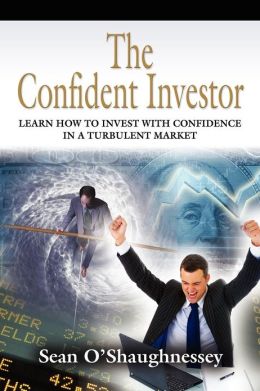
Since the publishing of my book, The Confident Investor, many people have asked for an explanation of the high-level strategy. It is difficult to summarize an entire book in one short article but I will try to give the essence of the system.
BN-TCI-cvr
First, it is important to understand some of my observed truths. If you disagree with these truths than the book is likely not for you.

  • Buy and hold is not a great investment strategy as it ties up your capital and subjects you to periods of bullish behavior by the stock.
  • It is okay to hold on to truly great companies that are very well run if it doesn’t affect your original capital.
  • Most stocks of great companies go up and down within a range that slowly grows over time
  • If you only own the stock during the good times and sell it during the bad times your profit will increase and your capital will be preserved

The basic strategy is to find truly great companies and grow your investment in these companies with free stock. It is easy to decipher the metrics that I think make up a great company – I regularly show how companies do on my grading system. I publish the best of these companies on my Watch List. The metrics are:

  1. The growth of the company’s sales.
  2. The growth of the company’s earnings per share of stock outstanding.
  3. The growth of the company’s market value compared to its earnings.
  4. The growth of the company’s earnings before taking into account interest and taxes.
  5. The value of the company compared to its earnings as compared to other similar companies.
  6. The productivity of the company employees relative to industry averages.

Once you identify a great company, the strategy is to acquire shares in that company for free. This is a strategy that I call GOPM (Grow on Other People’s Money). It isn’t a leveraged model where you are taking a loan out to buy stock. Rather, it is using technical analysis to know when to buy a stock and when to sell it. The investor should buy stock when it is bullish and then sell the principal when the stock enters bearish territory but keep the profit from the original purchase invested in shares of the company. These profit-owned shares were purchased with Other People’s Money. They are free for you since you conserved your original capital. This capital is now available to invest in another great company that is experiencing bullish conditions.

Over time, this strategy allows you to build up a substantial amount of shares in great companies. These shares are essentially free (or have cost very little per share).

There are many details to executing this strategy. Reading the book, The Confident Investor, is essential to understanding how to calculate the metrics and how to understand the technical analysis. The book is available wherever books and ebooks are sold such as Amazon, KindleBarnes and Noble, Nook, and iPad. Once you have purchased the book, you will be able to access private information on this site that is reserved for book owners.

The absolute first thing that a new investor should do before investing a single penny is too build up an emergency savings account. This account should be equal to 6 months of after-tax income. I spoke of this in a previous article and you may want to jump back and read it.

The Simple Dollar recently posted an article that gives a key technique in building up a savings account. Simply go to a different bank then the one that you currently patronize and open a new savings account. Then, have your employer take 10% (or more) of your after-tax income and automatically deposit that money in your new savings account. You will be far less likely to spend this saved money if it is in a separate account in a separate bank.

As I have said before on this site and in my book, The Confident Investor, if you do not have an emergency fund to fall back on in hard times, you will always be nervous about your investment decisions. Eliminate this nervousness and you start to become a Confident Investor.

Check out the Simple Dollar article – it is worth your time.

I was really happy to see this article in the Wall Street Journal.  I think it is much more efficient and profitable for investors to forego managed mutual funds and invest in index funds.

I think that most people should only have 20-40% of their portfolio in funds and the balance should be in high quality growth stocks like those on my Watch List and that I describe in my book, The Confident Investor.

Below are the first few paragraphs of the WSJ article.  I encourage you to jump over and read the entire article by Kirsten Grind.

Investors are jumping out of mutual funds managed by professional stock pickers and shifting massive amounts of money into lower-cost funds that echo the broader market.

Through November, investors pulled $119.3 billion from so-called actively managed U.S. stock funds in 2012, the biggest yearly outflow since 2008, according to the latest data from research firm Morningstar Inc.

At the same time, they poured $30.4 billion into U.S. stock exchange-traded funds. When combined with bond ETFs, total inflows to such funds were $154 billion, the largest since 2008.

The move shows growing investor distaste for volatility, as the dot-com crash in the early 2000s, the financial crisis in 2008 and recent botched episodes such as last May’s Facebook Inc. initial public offering have shaken investor confidence.

It also reflects the fact that many money managers of stock funds, which charge fees but also dangle the prospect of higher returns, have underperformed the benchmark stock indexes. As a result, more investors are choosing simply to invest in funds tracking the indexes, which carry lower fees and are perceived as having less risk.

In my book The Confident Investor I frequently discuss GOPM (Grow on Other People’s Money). This is a key concept in building your stock portfolio while reducing your financial risk.

Let me show you a quick example of how this works.

You buy 100 shares of company A (perhaps one that is on the Watch List on this site) at $40 with $10 in stock broker commission, so you have invested $4,010. Over the course of a few months, the stock rises to $44. Your investment is now worth $4,400. The technical indicators make you think that this great company will have a short-term pullback in its stock price, so you want to sit back while the market moves against the stock price. However, you still want your money to work for you at this great company. You sell just your initial investment ($4,010) plus the selling commission of $10. $4020 divided by $44 means 92 shares (or a net of $4,048). Your principle is safe (plus $28) and you still have 8 shares of this great company. These 8 shares were bought with Other People’s Money. You have not invested one cent of your own cash in these 8 shares of stock.  They are free!

Perhaps while the market is moving against company A, you buy shares in company B that is experiencing bullish action. This allows you to not have your money sit idle but rather continue to grow while you wait for company A to rebound.

Eventually, the indicators confirm that you should buy in again with company A. Perhaps this new position is $43. You reinvest your $4,048 minus $10 commission and buy 93 shares with $39 left over. You now own 101 shares for your original $4,000 investment with $39 left in your money market account. This $39 is earning interest in your money market account or could be applied to a different stock.

With this technique on a great company, over time your investment will increase and your downside risk will be minimized. However, it is important to remember that, with any investment, there will always be some degree of risk. By bouncing between several well-run companies, you can constantly keep your original investment capital growing even though some stocks are experiencing a bull market.

This is the just the first aspect of the techniques that are taught in my book. The real power lies in learning which companies are worthy of using GOPM. You could just trust my analysis on this site or you can buy my book and understand how you find truly excellent companies to consider for investment. The next tactic after finding the great companies is to anticipate the market and my book will help you with that as well.

I am very happy to announce that my book The Confident Investor is now available for sale in paperback or ebook format. You should be able to buy it wherever books are sold. There is also a 2 chapter preview available in PDF format in case your local bookstore doesn’t have the book on the shelf and you want to browse.


BN-TCI-cvr

Now that the book is published, this site will change slightly. I will still publish reviews of companies on a regular basis for all to read. I will also publish commentaries for all to read. However, I will now publish some information that simply doesn’t make sense unless you have read my book. In those situations, I am actually providing more free content for the people that have purchased my book.  As I explained in the book, content costs money in a book format while my site is basically free no matter how much content I put on it. Therefore, to reduce the page count of the book and keep the cost down, I am moving some valuable content to the site for the enjoyment of only the readers of the book. It is free to register to see this enhanced content if you own the book.

If you decided in January 2006 to invest $10,000 in Apple, you would have increased your profit an ADDITIONAL 10.8% by using the techniques taught in my book. That is an additional $10,100 in 6+ years to be added to your savings account! To achieve this amazing return, you would have invested in Apple using the techniques in my book rather than using a simple “Buy and Hold” strategy.

In the same 6+ year period, you would have INCREASED YOUR EARNINGS by 42% if you would have used the techniques of this book for an investment in Google!

Every hard worker that is saving for retirement or a college fund should read my book, The Confident Investor.

You work hard at your job and try to invest money for retirement. When you look at your investment returns, you don’t see your money growing very quickly. Many people have lost money in the stock market over the past couple years. My book teaches you how to find great companies and profitably invest in those companies.

The combination of technical analysis with data analysis and key financial metrics results in tools to buy stocks at the appropriate time in extremely well-run companies. The result is the Decennary Time Weighted Average (DTWA), Time Weighted Composite Average (TWCA) and the Confident Investor Rating (CIR).
This book is not a Get Rich Quick scheme. There is no fast and easy way to build wealth by doing ANYTHING legal. My book explains a proven system to identify great companies, purchase stock at a discount in those companies, and accelerate wealth-building over time.