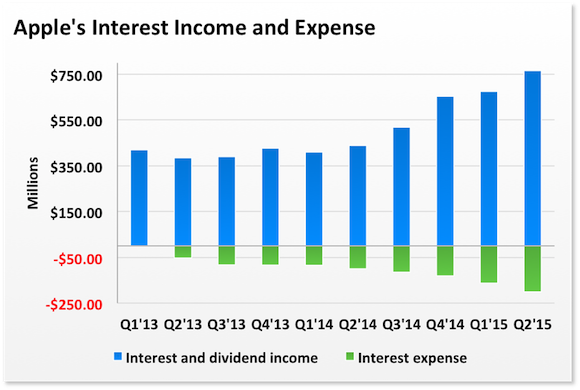
Over the past few years, the richest company in the world has continued borrowing increasing amounts of money from all over the world. Apple’s [stckqut]AAPL[/stckqut] debt position has ballooned considerably ever since it launched its capital return program in 2012. Including commercial paper and long-term debt (current and noncurrent), Apple had an incredible $54 billion in debt at the end of the second quarter, a figure that’s been steadily rising over the years.

What’s more, after the quarter closed Apple detailed plans to raise even more debt capital. The Mac maker sold $2 billion in its first sterling-denominated bond offering in July, then proceeded to sell another $2 billion in so-called “Kangaroo” bonds in Australia as it continues to diversify its credit investor base.

There are many benefits of this debt strategy that have been regularly noted by investors. Apple gets to avoid repatriation taxes since it doesn’t need to tap foreign reserves, which now consist of nearly 90% of total cash. It gets to fund its share repurchase program, driving significant earnings accretion. Heck, Apple even gets to lower its weighted average cost of capital, or WACC, by essentially swapping out equity capital for debt capital.

Even with the low-interest environment that we’re currently in, all that debt adds up and can cost a pretty penny. Yet here’s another reason why investors should love the company’s debt strategy: all that debt comes at no net cost.

Source: 1 More Reason Why Investors Should Love Apple Inc.’s Debt Strategy — The Motley Fool
In recent weeks, there has been some concern over technology giant Apple [stckqut]AAPL[/stckqut] due to a slowdown in China, its fastest growing market. As a result, a number of Apple suppliers have seen their shares pull back a bit, including Skyworks Solutions [stckqut]SWKS[/stckqut].

  • Shares have pulled back along with Apple.

  • Business remains strong, margins improving nicely.

  • Lower share price means higher dividend yield and stronger buyback.

  • Valuation seems a bit depressed considering expected growth profile.

Source: Skyworks Solutions: A Pullback To Strongly Consider – Skyworks Solutions, Inc. (NASDAQ:SWKS) | Seeking Alpha

Just a few companies are driving the gains in major U.S. stock indexes this year, raising fresh concerns about the health of the market’s advance.

Six firms— Amazon.com Inc. [stckqut]AMZN[/stckqut], Google Inc. [stckqut]GOOG[/stckqut], Apple Inc. [stckqut]AAPL[/stckqut], Facebook Inc. [stckqut]FB[/stckqut], Netflix Inc. [stckqut]NFLX[/stckqut] and Gilead Sciences Inc.[stckqut]GILD[/stckqut] —now account for more than half of the $664 billion in value added this year to the Nasdaq Composite Index, according to data compiled by brokerage firm JonesTrading.

Amazon, Google, Apple, Facebook, Gilead and Walt Disney Co. [stckqut]DIS[/stckqut] account for more than all of the $199 billion in market-capitalization gains in the S&P 500.

The concentrated gains are spurring concerns that soft trading in much of the market could presage a pullback in the indexes. Many investors see echoes of prior market tops—including the 2007 peak and the late 1990s frenzy—when fewer and fewer stocks lifted the broader market. The S&P 500 is up 1% this year while the Nasdaq has gained 7.4%.

Source: The Only Six Stocks That Matter

After a series of blockbuster earnings that blew past even the most optimistic of Wall Street expectations, Apple Inc. [stckqut]AAPL[/stckqut] felt the pain of falling short of elevated expectations.

Apple said Tuesday its profit surged 38%, aided again by strong demand for the company’s latest iPhones and robust growth in China where sales more than doubled. The gains lifted Apple’s cash reserves to a record $203 billion.

But while Apple sold 35% more iPhones in the fiscal third quarter compared with a year earlier, those sales missed some analysts’ estimates. Apple also indicated its revenue in the current quarter could come in below Wall Street projections.

Source: Apple iPhone Sales, Up 35%, Disappoint

Apple Inc. [stckqut]AAPL[/stckqut] has fallen victim to the “Curse of the Dow.”

Friday marks the three-month anniversary of Apple’s inclusion in the Dow Jones Industrial Average. It hasn’t exactly been a stellar three months for Apple’s stock.

The old Wall Street adage about the supposed “curse” goes as follows: Companies typically rally in the months leading up to their addition to the Dow 30, but underperform in the months that follow.

Since 1999, the 16 firms joining the Dow (Apple excluded) have seen their stocks increase an average 1% in the six months after their induction, according to data gathered by Birinyi Associates. That’s compared to gains of 11%, on average, for the companies in the six months preceding their inclusion.

Apple hasn’t reached the six-month mark yet. But three months later, its shares are down 0.5% after rising 13% in the three months leading up to their addition. The stock’s sideways action the past three months isn’t that different than the performance of the broader market. The Dow has risen 0.2% since mid-March, only slightly outperforming Apple.

“The ‘Curse of the Dow’ is alive and well,” said Nick Colas, chief market strategist at Convergex, referring to Apple’s performance.

You can read the rest of the article at the original source: Apple Plagued by the Curse of the Dow – MoneyBeat – WSJ