John Snow is a former Secretary of the Treasury. Anyone who has had that job is a far better predictor of the economy and how it will affect your personal portfolio than just about any writer.  Mr. Snow recently wrote an opinion in the Wall Street Journal about the affect of future taxes on the economy and the stock market.  His opinion is entitled “‘Taxmaggedon’ Is a Real Threat” and it is very enlightening.

I won’t reproduce the entire article here but I thought that these 4 points were worth repeating. These four points are his advice to policy makers and are reproduced from his commentary.

  1. First, remember the principle that you always get less of anything you tax. For this reason, society discourages undesirable activities by imposing so-called "sin" taxes. By the same token, high marginal tax rates discourage work, risk-taking and capital formation.
  2. Second, tax rates should be held as low as possible, consistent with maintaining fiscal balance. Low tax rates are not in conflict with fiscal sanity if the rate of government spending as a fraction of gross domestic product is reduced, or if the tax base is broadened with more fundamental tax reforms. It is encouraging to see so much interest gathering in support of changes to the tax code that would scrap many special tax breaks in favor of deeply lower marginal tax rates.
  3. Third, marginal tax rates should be as neutral as possible across different types of economic activities. Otherwise the tax code distorts behavior in ways that sap economic strength, as market participants rely less on market price signals and more on government commands to decide how economic resources are used. Social engineering through the tax code comes at a very high cost.
  4. Finally, policy makers should remember to "do no harm." A reversion to the kind of drastically higher marginal tax rates that existed in the past would be bad enough. It would only add insult to injury to use the economic crisis as an excuse to raise the tax burden on capital formation and thus reduce the lifeblood of America’s job creators.

It is my belief as a Confident Investor that whenever things change dramatically, the repercussions are difficult to predict. It is like dropping a rock into the smooth surface of a puddle. You know that there are going to be ripples but you really don’t know all of the splashing that is going to occur and what else is going to get wet.

If tax law significantly changes, you should be cautious with your principal and perhaps hoard more cash for the short term. You can always start to invest again when the market stabilizes and the ripples are gone.
I regularly get asked what tools that I use to analyze stocks. I am going to write about these tools in a series of posts. I want to clarify that I am not saying negative things about other sites and tools. In fact, I am sure that other tools can provide similar benefits and features.

When I first look at a company, I use two tools: MSN Money and Google Finance. I find that I can understand most of what I need to look quickly at a company with these two tools. I will first focus on Google Finance, and in a subsequent post, I will explore MSN Money.

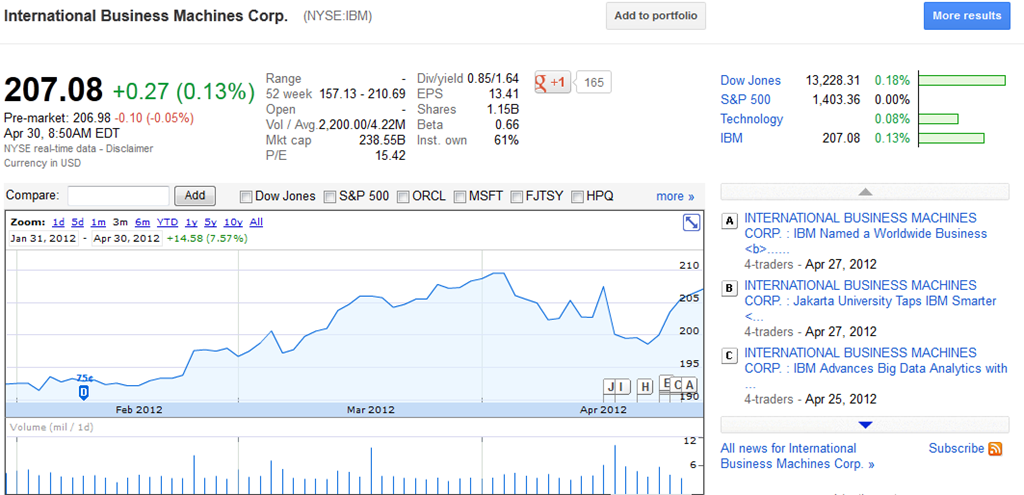
I usually receive requests via Twitter (follow me @ConfidentInvest) or the contact form on this site. The request is usually something like, "What do you think of XYZ?" My first step when someone asks me about an unfamiliar company is to go to Google Finance. I can quickly determine the company’s profitability, the major competitors, and then review recent news that is affecting the stock.

If you have read my site for any length of time, you will notice that the company must be profitable if I am going to invest. This is extremely obvious at the top of the Google Finance screen. If the company is not profitable, then I am done. I reply to the inquiring individual not to invest in unprofitable companies because it is extremely difficult to be confident in their actions.

Google 3 month stock history

I set the trading history on the stock chart to 3 months on my first review. My goal is to determine the dividend history. I also check out some of the articles that may be relevant to the company. This only takes a few minutes, but it allows me to see if there is any news about the company that may be influencing price moves. Also, since my site is called Confident Investor, a 3 month history will give me some idea of the volatility of the stock.

Google Finance competitors listing

I then scroll down to the competitors. Do I know any of them? If I already invest in one of the competitors, I can do a comparison of the two stock histories. This gives me an idea if this new company is a better investment than the original company. I also do a quick comparison of the P/E between the competitors. If it is not in line, there may be a problem. If the P/E is too high compared to its competitors, I will need to figure out why investors pay a premium for this company. If the P/E is too low, why are they punishing the company? P/E is a excellent indicator to see if investors like or dislike a company.

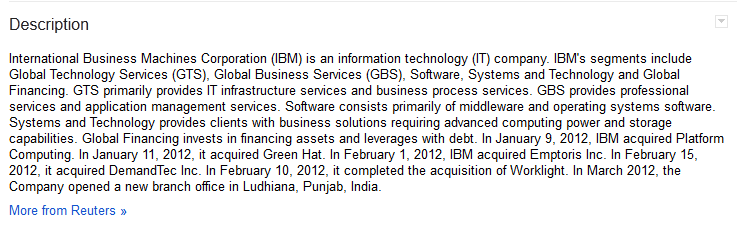
Google Finance Description

Finally, I do a quick read of the Description of the company. I usually know what the company does , but this quick read confirms it.

This is my first review of the company. At this point, I may be able to inform the inquirer if I dislike the company , but I cannot tell if I like the company. To do that, I need to go to MSN Money – I will review that tool in a later post. Stay tuned.

If you want to be warned when I post about MSN Money, there are several straightforward ways to do this. You can subscribe to my feed in your news reader. You can also sign up for my weekly newsletter which will give you the articles for the week. Finally, you can subscribe to my Twitter account @ConfidentInvest.

A frequent question that I get on twitter (@ConfidentInvest) or on emails sent to me via this site is:

Why do I look at EBIT?

In particular, why do I look at the growth of this value?

My answer to this is quite straightforward, but first it my make sense for you to take a quick refresher on EBIT. Rather than typing a lot of words, I am going to ask Hamilton Lin of Wall Street Training to explain it.

As you heard Mr. Lin explain at about 1:20, EBIT is the core sustainable profitability from the core operations of the company. In other words, this is what the company does as a company, and this is how much the company makes for doing it. It is just simply logical that we want to look at this core value, and we want this core value to grow!

There are other metrics that I use to analyze a company. It concerns me when an analyst recommends a company that cannot get its core operations to grow. If the stock price is growing faster than the core operations is growing (taking into account the multiplier effect of P/E) then either the company was too cheap before or it is too expensive now.

Last week, I discussed the one best investment that a new investor could make. I advised that this investment should be a group of companies (such as my Watch List) and the small investor should move the principle between “hot” stocks.

The money invested in stocks needs to be money that you do not need immediately. This does not mean that it is not necessarily money that you will not need for 20-30 years. If you have money that you are confident that you will not need for decades, you should probably invest that money in your own home. Follow the old Benjamin Franklin saying: "A penny saved, is a penny earned."

If you currently pay 7% interest on your home loan, any extra money that you apply to your mortgage will immediately give you a 7% return for the balance of your mortgage time. Therefore, paying a one-time extra $1,000 on a 7% mortgage that has 23 years left on it, then it will result in $5,002.04 that you did not have to pay over the course of the 23 years. This is an absolutely guaranteed return – over the course of 23 years you will be over $5,000 wealthier due to that one-time investment.

Your home mortgage is the safest "buy and hold" investment that you can make! You already know that you pay a certain percentage. If you pay the loan off early, you effectively make that loan percentage as an investment return.

The same logic goes for your car loan your credit cards. This is typically more short-term debt than your home. Quick payoff on any short-term debt will guarantee you the quickest and best investment strategy. You are not spending those pennies; you save them. Benjamin Franklin will be proud of your efforts to pay off your short-term and long-term debt quickly and efficiently.