This is a light week for investing. Many professional brokers take this week off so the market is not very predictable. As I wrote last week, I suggest that you lay back and enjoy your family for today and the rest of the week. Don’t worry about your portfolio but instead enjoy your family and say a prayer or a kind thought for our military men and women.

Editors Note: I don’t know the source of the above image but I was told that is was public domain. If you own the copyright to this image and want it removed, please contact me and I will immediately remove it.  I have no wish to reduce an artist’s income.

There will be a national holiday in the US next week on Wednesday, July 4th. This may seem obvious to anyone looking at the calendar but it is very important for investors.

Many professional investors will be on vacation all next week.  More importantly, their bosses will likely be on vacation next week.  Be careful of your investments during times when major mutual funds and investment companies have large percentages of their executives on vacation. Many of the trades will be on “autopilot” and the market volume is likely to be down.

As a habit, I rarely initiate a new position on a short work week.  Also, I never initiate a new position on the week of Thanksgiving or when the national holiday is on Tuesday, Wednesday, or Thursday. I even try to avoid the first work day after a 3-day weekend.

You may have a different experience but avoiding these shortened work-weeks has been good for my portfolio.

I recently read an article on CNN Money advising investors to invest in consumer product goods (CPG) companies. The logic was that CPG companies, as a group, have several features that should be appealing to investors:

  • Predictability – these companies can predict how much of a product can be sold in the short-term so they control pricing and inventory well.
  • Dependability – these companies are not going to see massive drops in revenue since consumer purchase their products regardless of the economic climate.
  • Pricing power – due to their brand loyalty, these companies can put forward regular price increases with little negative market reaction.
  • Global reach – while most of CPG companies get the bulk of their revenue in the western world, many have made significant investments in emerging markets.

The problem with the article is that the cited companies were fair at best, and some were poor. Instead of the CPG companies in the article, I suggest that you look at good companies such as Coach [stckqut]coh[/stckqut], Decker [stckqut]deck[/stckqut], Boston Beer [stckqut]sam[/stckqut], or Fossil [stckqut]fosl[/stckqut] (all of these companies are currently on my Watch List). If you want to own one or two of the companies in the article, P&G [stckqut]pg[/stckqut] (the stock symbol is not PR as cited in the article) or Unilever [stckqut]ul[/stckqut] are decent candidates – both companies are very well run.

Settling for companies that are familiar to you and you see on the grocery shelves may not be a good investment strategy.  I suggest that you focus your portfolio on companies that have more upside potential but are still very well run.

I recently discussed how I use Google Finance to do part of my "quick" analysis of a stock when a reader asks my advice. Typically, I receive these requests from Twitter (@ConfidentInvest) or via the Contact Me on this site. After I do the quick review of a company on Google Finance, I need to dig in a bit more before I give an opinion on the stock. Most of that work, I do on MSN Money.

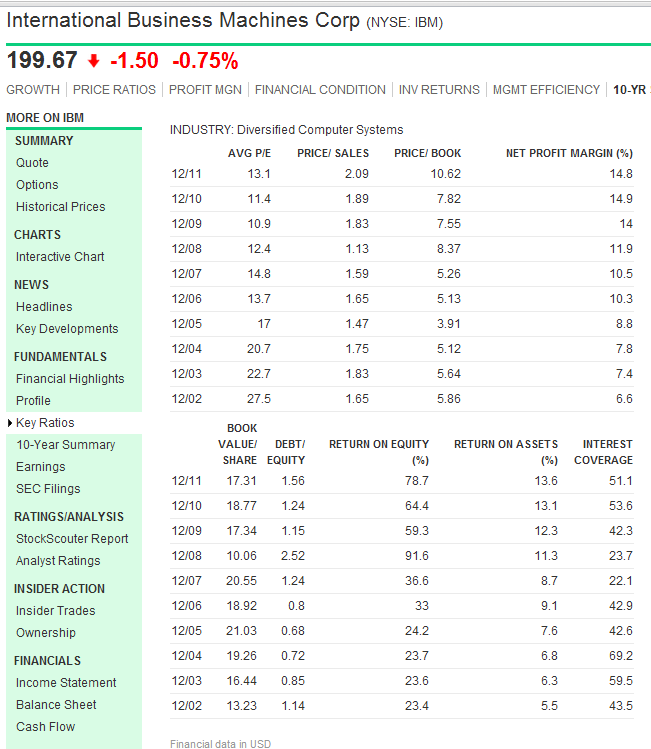
As you can tell by the metrics I report in my analysis reports, I worry about the 10 year growth history of 4 major metrics:

  1. P/E
  2. EBIT
  3. Sales
  4. Profit

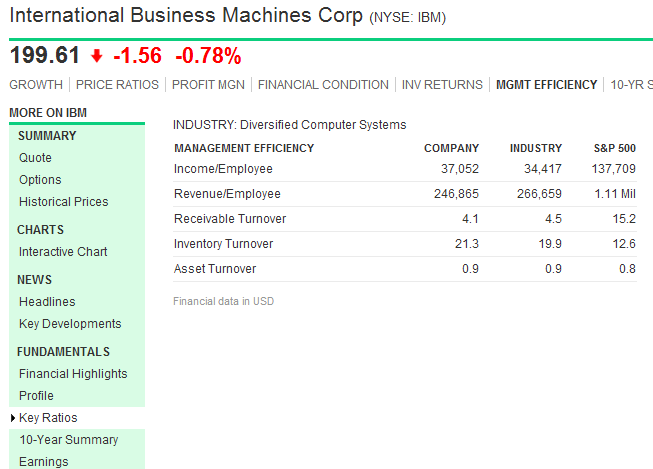
I also look at the ability of a company’s managers to manage their revenue and profitability as a function of the number of employees.

image

image

To find the 10 year history, go to 10-Year Summary on the left side of the page. Also go to Key Ratios and further select 10-YEAR SUMMARY across the top of that page. When I do a full analysis for my site, I enter these values into a spreadsheet and perform trend analysis that closely models the rate of growth. I call this deep analysis TWCA and will explain more about that technique in the future. However, for a quick response to a reader’s question, I will do a mental calculation that the values are growing at a fairly even pace over the past decade. My concern is a major change in the numbers (especially negative growth). If the growth is relatively consistent, then I assume that a Confident Investor can cautiously invest in the company.

image

I then quickly look at the revenue per employee and then income per employee. This is found in the Key Ratios section but under MGMT EFFICIENCY on the top. I want to compare these numbers to the averages in the specific industry as well as to the S&P500. Companies that have too little revenue or profit per employee may be out of control and be heading into a rough time. This isn’t an albatross, but it does give me some concerns. For instance, in the screen shot above, IBM is significantly lower than the industry as well as the S&P 500.

At this point, I can answer the inquisitor. On an email or Twitter response, it is usually not very definitive. For a quick look, I haven’t done the math to rate the stock as a Good Company, Fair Company or Poor Company. However, if my quick look is interesting, I will add it to my list of stocks to spend more time with and perhaps create an analysis here.

When I find a company that I like and have on my Watch List, I use my account on Fidelity to manage my investment. I am very open on my Disclaimer page that you can expect that I personally invest in companies that I find attractive. Other brokerage houses have similar tools that I am sure are quite good, but I really like Fidelity’s tools.  In a future post, I will write about what I do there. If you want to make sure that you don’t miss my posts, please follow me on Twitter (@ConfidentInvest), subscribe to the RSS feed of this site, or subscribe to the weekly digest email that is sent out on Monday.