In July, I cautioned readers that Netflix [stckqut]nflx[/stckqut] may be at risk. By the end of the article, I suggested that you should be cautious but NFLX management would have a plan to maintain revenues and earn investor’s confidence. At the time, the stock was well above $250 and now it is well below $100 as I write this article. Hopefully in the time between these two articles you were watching the market indicators and you ended your ownership of the company. At this time on this site, I don’t offer specific instructions on when to buy, sell, or hold – I just suggest companies that are worthwhile for you to consider or not to consider.

But what if you didn’t sell in August and September as the stock was falling like a skier going down a black diamond ski trail only to watch that skier go over a cliff in October? Should you sell now? What if you watched the amazing fall from the sidelines – should you buy now?
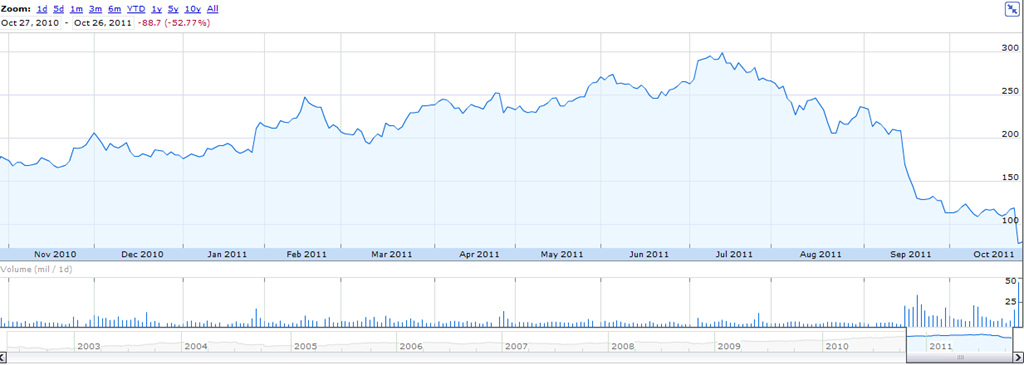
NFLX from Google Finance (http://www.google.com//finance?chdnp=1&chdd=1&chds=1&chdv=1&chvs=maximized&chdeh=0&chfdeh=0&chdet=1319716458318&chddm=98923&chls=IntervalBasedLine&q=NASDAQ:NFLX&&fct=big)

Henry Blodget has very well written article over at Business Insider that suggests that NFLX has gone down too far.  The article is titled “Sorry, But This Netflix Collapse Is Overdone” so you won’t be surprised that he is suggesting that at this price NFLX is too cheap. Here are the highlights of his article:

  • Netflix appears to be just going through a product transition. – If so, then it is a really tough product transition. It seems more likely that Netflix was starting to believe that it was as wonderful as the investment rags suggested.
  • It’s not Reed Hastings’ fault all those magazines put him on their covers a couple of years ago. – This doesn’t actually make sense – are we suppose to buy because it wasn’t his fault? Is Mr. Hastings really comparable to Mr. Bezos as the article suggested?
  • Netflix’s streaming business, its future, is already at a ~$2 billion revenue run-rate, with 21 million subscribers paying $8/month. – This is true but it is based on streaming content that appears to be greatly in flux so what if subscribers quit because the quality is not sufficient.
  • At $75 a share, Netflix’s market cap is $4 billion, or 2X the revenue of its product of the future. – This is probably the point that makes the most sense in Blodget’s article. Of course, I am primarily interested in fundamentals so I would gravitate to the portion of the article that required the use of a calculator.
  • Netflix’s streaming business, after all, is similar to HBO’s business in many key ways. – This is a fair point but HBO has easier access to consumers through the various operators and HBO typically doesn’t have a second bill that consumers have to pay where Netflix does.
  • Netflix may well prove to be a much better business than HBO, because it won’t be beholden to the cable operators for distribution.  – Not sure that I buy this argument since those evil operators are a great way to get access to the consumer which Netflix needs to do with its own promotion and billing. I think Netflix’ true competition is Apple’s and Amazon’s streaming service.
  • To believe that Netflix is worth less than 2X the current revenue of its streaming business, you have to believe that content providers will always be able to sock it to Netflix whenever Netflix posts a few dollars of profit. – This is a pretty weak argument since Netflix has not shown that it can hold on to and sufficiently acquire streaming content deals.

I will be putting out an analysis on Netflix very soon. If you are not subscribed to my news feed or newsletter subscription then you are missing out and will just have to come back regularly. In that upcoming article, I will try to give some advice on where I think the price should be.

In the meantime, if you owned the stock at $300 and still own it today at 75% lower, you have already suffered the worst of your injury and you should probably hold for a bit of a rebound. If you do not own the stock today, my upcoming article will tell you if I still think the stock is a Good Company worthy of your trading and investment dollar.

The above stock chart is from Google Finance.

It is almost not possible to turn on the news without hearing about Occupy Wall Street. This “uprising” has now morphed into Occupy [name your city] all over the country. So where do you rank?  Are you a member of the elite 1% or the struggling 99% that is supposed to be represented by the campers in parks all across America?

There are two great calculators to see how you rank.  The first calculator is on Kiplinger and it simply compares your income level to the rest of America.  The second calculator is on MSN and digs in a bit more and compares your income, assets, and debt to the median as well as your “peer group” of people that have your income and are in the same age group.

It is worthwhile to do both calculators. For me, I am not in the top 1% but I am considerably higher up the scale than the majority of Americans. On the MSN calculator I was not surprised to see I had far less debt, far more savings invested and my house was worth less than others in my peer group.  This revelation didn’t surprise me as that is a big reason that I run this site – I have learned a lot about creating wealth and it shows when compared to most people that are my age and have the same level of income.

I suggest that you take the test.  It takes less than 5 minutes on either site and it may reveal more than you thought.  While you are at it, enjoy this little image that I found on digg.com.

I think I understand the new iPhone and Tuesday’s lack of fan fare by Apple [stckqut]aapl[/stckqut].  It wasn’t because Steve Jobs was literally on his death bed but rather because they could reasonably assume that Steve wasn’t going to be around next Spring/Summer.  Granted that they should have decreased expectations for a new iPhone5 and especially silenced the members of the board that set the wrong expectation (can Gore be trusted on anything these days?).

Apple is doing great right now:

  • more than holding its own in the phone market (yes, Android sells more but all phones are compared to the iPhone and together iPhone/Android are destroying everyone else),
  • no significant challengers to the iPad or iPod,
  • Mac sales are higher than ever
  • over $75B in assets

It is reasonable to assume that Apple has the iPhone5 nearly done but maybe could not have the supply of product that would be required for its delivery. They would need more phones in inventory than ever produced by any company. The last thing the non-Jobs era Apple needed was to not be able to thrill everyone on delivery so being a bit more cautious was likely a wise move. Apple could not afford a supply problem going into the holiday season and they couldn’t ‘pre-announce’ a new phone as that will destroy sales of their current phones.

Apple didn’t need an amazing event this time, they needed to execute on a slightly better product and they definitely did it.  The 4S is arguably better than any phone on the market today and definitely good enough that no one is going to say, "I will never buy that slow and ugly thing.”  iOS5 is definitely an improvement and Android is going to have a hard time leapfrogging it – especially for tablets.

I continue to be bullish on Apple at least for everyone but day-traders. My last review of the company was on August 29 and I still think they are setup to achieve a great long-term stock price.  As a disclaimer that I fully state elsewhere on this site, at any time I may be long Apple.

What this sets up is a very strong event next Spring.  It could bring the iPad3 and the iPhone5 which will dominate electronics sales for the spring.  Also, it means that the amazing number of 4 owners will be very near their 2 year contracts and itching to buy a new phone without a lot of pain to the carriers (an iPhone5 now would cause a lot of pain to VZW and ATT as they dealt with upgrade requests for contracts with only 8-16 months covered).

In the spring, a strong announcement on a cool set of devices will significantly bounce the stock price of Apple. It will mean that Apple is surviving without its iconic CEO. It will mean that Apple learned from Jobs to "think different."

Of course, this will also mean that Apple has lost its luster if they have a lackluster event next Spring – if that happens then the stock will plummet.

Many others will write obituaries or pontificate about the inability for Apple to be the driving force in computing without the visionary Steve Jobs. Instead, I will simply say that the world was a better place because he was here and I think that is all any of us could ask for.

RIP Steve Jobs.

Here is the early (and obviously mostly pre-written) obituary in WSJ.com (sorry I am simply going to plagiarize the entire article – I don’t usually do this but in this one single case I will break my rule):

http://online.wsj.com/article/SB10001424052702304447804576410753210811910.html?mod=WSJ_Home_largeHeadline

By YUKARI IWATANI KANE And GEOFFREY A. FOWLER

Steven P. Jobs, the Apple Inc. chairman and co-founder who pioneered the personal computer industry and changed the way people think about technology, died Wednesday at the age of 56.

“Steve’s brilliance, passion and energy were the source of countless innovations that enrich and improve all of our lives,” Apple’s board said in a statement. “The world is immeasurably better because of Steve.”

His family, in a separate statement, said Mr. Jobs “died peacefully today surrounded by his family…We know many of you will mourn with us, and we ask that you respect our privacy during our time of grief.”

The company didn’t specify the cause of his death. Mr. Jobs had battled pancreatic cancer and several years ago received a liver transplant.In August, Mr. Jobs stepped down as CEO, handing the reins to Tim Cook.

During his more than three decade-long career, Mr. Jobs transformed Silicon Valley as he helped turn the once sleepy expanse of fruit orchards into the technology industry’s innovation center. In addition to laying the groundwork for the modern high-tech industry alongside other pioneers like Microsoft Corp. co-founder Bill Gates and Oracle Corp. founder Larry Ellison, Mr. Jobs proved the appeal of well-designed intuitive products over the sheer power of technology itself and shifted the way consumers interact with technology in an increasingly digital world.

Unlike those men, however, the most productive chapter in Mr. Jobs’ career occurred near the end of his life, when a nearly unbroken string of innovative and wildly successful products like the iPod, iPhone and iPad fundamentally changed the PC, electronics and digital media industries. The way he marketed and sold those products through savvy advertising campaigns and its retail stores, in the meanwhile, helped turn the company into a pop culture icon.

At the beginning of that phase, Mr. Jobs once described his philosophy as trying to make products that were at “the intersection of art and technology.” In doing so, he turned Apple into the world’s most valuable company.

After exhibiting significant weight loss in mid-2008, Mr. Jobs took a nearly six month medical leave of absence in 2009, during which he received a liver transplant. He took another medical leave of absence in mid-January without explanation before stepping down as chief executive in August.

Mr. Jobs is survived by his wife, Laurene, and four children.

Although his achievements in technology alone were immense, Mr. Jobs played an equally groundbreaking role in entertainment. He turned Apple into the largest retailer of music and helped popularize computer-animated films as the financier and CEO of Pixar Animation Studios, which he later sold to Walt Disney Co. He was a key figure in changing the way people used the Internet and how they consumed music, TV shows, movies, books, disrupting industries in the process.

Mr. Jobs also pulled off one of the most remarkable comebacks in modern business history, returning to Apple after an 11-year absence during which he was largely written off as a has-been and then reviving the then-struggling company by introducing products such as the iMac all-in-one computer, iPod music player and iTunes digital music store.


The company produces $65.2 billion a year in revenue compared with $7.1 billion in its business year ending September 1997. Apple has become one of the world’s premier designers of consumer-electronics devices, dropping the “computer” in its name in January 2007 to underscore its expansion beyond PCs.

Although Mr. Jobs officially handed over the reins of the company to long-time deputy Tim Cook in August, his death nevertheless raises a high-stakes question for Apple of how the company—which has been in the vanguard of technological creativity for most of the past decade—will sustain its success without his vision and guidance. Other icons of American capitalism, including Walt Disney, Wal-Mart Stores Inc. and International Business Machines Corp., experienced some transitional woes but eventually managed to thrive after their charismatic founders passed on.

But few companies of that stature have shown such an acute dependence on their founder, or lost the founder at the peak of his career. Several years after Mr. Jobs was fired from Apple in 1985, the company began a steady decline that saw it drift to the margins of the computer industry. That slide was reversed only after Mr. Jobs returned to Apple in 1997.

Mr. Jobs also leaves behind innumerable tales about his mercurial management style, such as his habit of calling employees or their ideas “dumb” when he didn’t like something. He was even more combative against foes like Microsoft Corp., Google Inc., and Amazon.com Inc. When Adobe Systems Inc. waged a campaign against Apple for not supporting Adobe’s Flash video format on its iPhones and iPads in April 2010, Mr. Jobs wrote a 1,600 word essay about why the software was outdated and inadequate for mobile devices.

The CEO maintained uncompromising standards about the company’s hardware and software, demanding “insanely great” aesthetics and ease of use from the moment a consumer walked into one of Apple’s stylish stores. His attention to the smallest details in the development and design process were instrumental in shaping some of the most distinctive features of Apple’s products, while his meticulously planned onstage demonstrations helped fuel excitement that was unmatched by his peers.

At event after event to introduce new Apple products, Mr. Jobs often puckishly proclaimed “There is one more thing” before revealing the most significant news at the very end of a speech. He enforced strict secrecy among Apple employees, a strategy that he believed heightened anticipation for upcoming Apple products.

Mr. Jobs, the adopted son of a family in Palo Alto, Calif., was born on Feb. 24, 1955. A college dropout, he established his reputation early on as a tech innovator when at 21 years old, he and friend Steve Wozniak founded Apple Computer Inc. in the Jobs family garage in 1976. Mr. Jobs chose the name, in part, because he was a Beatles fan and admired the group’s Apple records label, according to the book “Apple: The Inside Story of Intrigue, Egomania, and Business Blunders” by Wall Street Journal reporterJim Carlton.

The pair came out with the Apple II in 1977, a groundbreaking computer that was relatively affordable and designed for the mass market consumer rather than for hobbyists. The product went on to become one of the first commercially successful personal computers, making the company $117 million in annual sales by the time of Apple’s initial public offering in 1980. The IPO instantly made Mr. Jobs a multimillionaire.

Not all of Mr. Jobs’s early ideas paid off. Apple’s Apple III and Lisa computers that debuted in 1980 and 1983 were flops. But the distinctive all-in-one Macintosh–foreshadowed in a ground-breaking TV ad inspired by George Orwell’s novel “1984” that famously only aired once — would set the standard for the design of modern computer operating systems, in which users point and click on icons with a mouse rather than typing in commands.

Even then, Mr. Jobs was a stickler about design details. Bruce Tognazzini, a former user-interface expert at Apple who joined the company in 1978, once said that Mr. Jobs was adamant than the keyboard not include “up”, “down,” “right” and “left” keys that allow users to move the cursor around their computer screens.

Mr. Jobs’s pursuit for aesthetic beauty sometimes bordered on the extreme. George Crow, an Apple engineer in the 1980s and again from 1998 to 2005, recalls how Mr. Jobs wanted to make even the inside of computers beautiful. On the original Macintosh PC, Mr. Crow says Mr. Jobs wanted the internal wiring to be in the colors of Apple’s early rainbow logo. Mr. Crow says he eventually convinced Mr. Jobs it was an unnecessary expense.

Many ideas in the Macintosh came from a visit in 1979 to Xerox Corp.’s Palo Alto Research, where Mr. Jobs saw a machine called the Xerox Alto that had a crude graphical user interface and a mouse. The episode underscored his recurring role as a refiner and popularizer of existing inventions.

“Picasso had a saying, ‘Good artists copy. Great artists steal,'” Mr. Jobs said in a PBS documentary on the computer industry from the mid-1990s. “I’ve been shameless about stealing great ideas.”

Even in his appearance, Mr. Jobs seemed to cultivate an image more like that of an artist than a corporate executive. In public, he rarely deviated from an outfit consisting of Levis jeans, a black mock turtleneck and New Balance running shoes.

As Apple expanded, Mr. Jobs decided to bring in a more experienced manager to lead the company. He recruited John Sculley from Pepsi Co. to be Apple CEO in 1983, famously overcoming Mr. Sculley’s initial reluctance by asking the executive if he just wanted to sell “sugar water to kids” or help change the world.

After Apple fell into a subsequent slump, a leadership struggle led its board’s decision to back Mr. Sculley and fire Mr. Jobs two years later at the age of 30. “What can I say – I hired the wrong guy,” Mr. Jobs brooded in the same PBS documentary. “He destroyed everything I had spent ten years working for.”

Mr. Jobs then created NeXT Inc., a closely watched startup that in 1988 introduced a distinctive black desktop computer with advanced software that was initially targeted at the academic computing market. But the machine was hobbled by its exorbitant price tag and some key design decisions, including its use of an optical disk drive and a Motorola Inc. microprocessor at a time when Intel Corp. chips and floppy drives had become the norm.

NeXT eventually stopped selling hardware and failed to make money as a software company. But its operating system would become a foundation for OS X, the software backbone of today’s Macs, after Apple purchased NeXT for $400 million in December 1996.

In 1986, using part of his fortune from Apple, Mr. Jobs paid filmmaker George Lucas $10 million to acquire the computer graphics division of Lucasfilm Ltd. The company he formed out of those assets, Pixar Animation Studios, first sold hardware, then software, and later turned to feature films. Pixar went on to create a string of computer-animated hits, from “Toy Story” to 2008’s “Wall-E.” Mr. Jobs sold Pixar to Disney in January 2006 in a $7.4 billion deal that gave him a Disney board seat and made him the entertainment company’s largest shareholder.

Meanwhile, Apple began foundering. Computers using Intel chips and Microsoft software grew to dominate the market, a trend that accelerated after Microsoft’s Windows emulated many elements of the Mac’s visual interface.

Apple, by contrast, had to finance both hardware and software development internally. Fewer developers of application programs created products to make the Macintosh more useful. Apple would eventually decide to license its operating system to other hardware companies, but it was too late to reverse the swing to Windows-based machines.

By 1997, Apple had racked up nearly $2 billion in losses in two years, its shares were at record lows and it was on its third CEO–Gil Amelio–in four years. Eight months after the deal to buy NeXT in December 1996, Mr. Amelio was ousted and Mr. Jobs appointed interim CEO, a title that became permanent in January 2000. One former Apple employee recalls Mr. Jobs joking soon after he returned that “the lunatics have taken over the asylum and we can do anything we want.”

Mr. Jobs, who was given a salary of $1 a year along with options to Apple stock, made a series of changes that started paying off quickly. He ended the nascent software licensing program that created Mac clones, killed the struggling Newton handheld computer and trimmed a confusing array of Mac models to a handful of systems focused on the consumer market.

In May 1998, he introduced the iMac, an unusual one-piece computer that sported a colorful casing in translucent turquoise and gray. The popular machine–which sent competitors scrambling to improve their own designs—was embodied by a bold ad campaign that featured the phrase “Think Different,” with the picture of one of Mr. Jobs’s heroes, such as Albert Einstein and Muppets creator Jim Henson.

While shareholders cheered the changes, Mr. Jobs flexed his power on Apple’s Cupertino, Calif., campus. Within months of taking over, he had replaced four of the five top executive positions with former NeXT underlings. He issued emails forbidding employees on the famously laid-back campus to bring pets to the office, smoke even in parking lots, and threatening to fire anyone caught leaking company documents.

One personal assistant became a target when he failed to arrange the installation of a high-speed digital data line to Mr. Jobs’s office fast enough to suit the interim CEO. The worker said Mr. Jobs fired him for the delay, but rescinded the firing the next day after he had cooled down. (The worker ended up resigning soon afterwards).

Apple had some stumbles during Mr. Jobs’s second coming, including a cube-shaped Macintosh that failed to catch on and was scrapped in 2001. The failure was one reason that Apple posted a quarterly loss and warned it would miss estimates several times in 2000 and 2001.

But big hits followed. In 2001, Apple introduced a PowerBook laptop made from titanium, a metal more frequently found in fighter airplanes. The same year, it introduced the iPod, which transformed digital music players with features such as its smooth shape and DJ-like wheel for navigating through songs. As of Sept. 2010, Apple had sold more than 275 million iPod devices since its introduction, and it has more than 70% market share in the market for digital music players.

A key differentiator was the iTunes Music Store, opened in 2003. At the time, the music industry was largely sitting on the sidelines of the digital revolution, badly wounded by illegal downloads but unable to agree on an easy, inexpensive way to sell songs online. But Mr. Jobs helped convince major record labels to sell recordings for 99 cents each, along with antipiracy restrictions that most consumers found acceptable.

The store, which has sold more than ten billion songs, became the largest music retailer in the U.S. in 2008. It also became an incentive for consumers to buy iPods because, for much of its history, songs from the iTunes store could only be downloaded to Apple’s music player and not devices made by other companies.

At the same time, Mr. Jobs was building a deep bench of executives. He recruited former Compaq Computer Corp. executive Tim Cook in the late 1990s to straighten Apple’s operations and promoted him over time to chief operating officer. Ron Johnson, senior vice president of Apple retail, was hired from Target Corp. in 2000 to launch Apple’s stores worldwide. Apple’s lead industrial designer Jonathan Ive took charge of the physical look-and-feel of the company’s products and is said to share in Mr. Jobs’s sensibilities about design.

In 2004, Mr. Jobs had to lean on this bench when he disclosed that he had had surgery to remove a cancerous tumor from his pancreas. Apple revealed the procedure in early August 2004, but a person familiar with the situation said Mr. Jobs first learned of the tumor during a routine abdominal scan nine months earlier. The board and Mr. Jobs said nothing to Apple shareholders as the Apple executive, during that time, dealt with the tumor through changes to his diet, the person said.

In June 2007, Mr. Jobs made another splash when Apple introduced the iPhone. The cellphone pushed the envelope in the mobile phone market with features that included a touch-screen interface, allowing tricks such as blowing up images by spreading a thumb and finger on the phone’s surface.

Mr. Jobs was typically hands on in the creation of the iPhone. People familiar with the matter say the CEO was the one that made a decision to change the screen of the iPhone from plastic to glass after he unveiled the product at the Macworld trade show in 2007. The iPhone team scrambled to procure glass that would meet his exacting standards, so the devices could be manufactured in time for the launch, which took place just seven months later.

Despite skepticism about Apple’s ability to enter an already-competitive market dominated by the likes of Research in Motion Ltd.’s Blackberry devices, Apple quickly became a force in the mobile phone market, selling 92 million iPhones as of December 2010. The product kicked into a higher gear earlier this year when Apple said it would begin selling iPhones through Verizon Wireless in addition to carrier AT&T.

Last year, Mr. Jobs also unveiled the iPad tablet computer to great fanfare, billing it as “magical and revolutionary”. In the first nine months of the product’s release, Apple sold 14.8 million iPads as consumers snapped them up to use as a casual multimedia device for activities such as emailing, watching video and reading. People who work closely with Mr. Jobs said the project was so important to him that he was intimately involved in its planning even while recovering from his 2009 liver transplant.

A major selling point for both the iPhone and iPad has been the App Store, which allows developers to easily make application programs that users can download for free or for a small fee; the store meanwhile has seen more than seven billion downloads as of the end of 2010.

One cloud to Mr. Jobs’s reign came in 2006 when Apple also disclosed that an internal investigation had discovered that stock option grants to Apple executives between 1997 and 2002– including to Mr. Jobs– were improperly dated. Apple became the most high-profile technology company caught up in a broad series of options backdating scandals that helped inflate the profits executives made from their stock awards.

Apple later disclosed that Mr. Jobs helped select the favorable option dates, but denied that he did anything wrong since he didn’t understand the accounting implications of his actions. Apple’s investigation ended up blaming two ex-Apple executives – former general counsel Nancy Heinen and former chief financial officer Fred Anderson – for their role in the backdating. Both were later charged by the Securities and Exchange Commission. They ended up settling the charges. Mr. Jobs was never charged with any wrongdoing.

Those who knew Mr. Jobs say that one reason why he was able to keep innovating was because he didn’t dwell on past accomplishments or legacy but kept looking ahead and demanded that employees do the same. Hitoshi Hokamura, a former Apple employee, recalls how an old Apple I that was displayed by the company cafeteria quietly disappeared after Mr. Jobs returned in the late 1990s.

“Remembering that you are going to die is the best way I know to avoid the trap of thinking you have something to lose,” Mr. Jobs said in a commencement speech at Stanford University in June 2005, almost a year after he was diagnosed with cancer.

—Pui-Wing Tam, Don Clark and Jim Carlton contributed to this article.

Read more: http://online.wsj.com/article/SB10001424052702304447804576410753210811910.html#ixzz1ZxNfJ9Ik