Too many people misinterpret “buy and hold” as “buy and hold no matter what.” A better phrase would be “buy to hold,” as this reflects the true intention of long-term investing. When you buy to hold, you hold the investment for as long as it makes sense to do so. You should consider each investment as a new investment for that day. Do not own an asset that does not make sense.

If something changes in the investment, market, or your goals, “bought and sold” is the way to go. As an investment strategy, “sell” is not a four-letter word.

If you make a mistake in your business analysis, or if the company moves in a different direction than you expected, you sell. In addition, if the reaction of the market agrees with your analysis, and the stock that was once a good deal with plenty of benefits is now just a solid stock that probably will not drop, you should divest your initial investment to let your earnings grow on their own.

Your goal should be to sell as infrequently as possible and only to minimize the inevitable drops in the market. Ultimately, “buy to hold” simply means you need to do your homework, find a great business to own for a while, and check it regularly to re-balance and re-evaluate.

I try to help you decide the right companies on this site. I use the tools that I teach in my book, The Confident Investor. If you really want to increase your wealth then your first investment should be to buy my book. You can purchase my book wherever books are sold such as AmazonBarnes and Noble, and Books A Million. It is available in ebook formats for NookKindle, and iPad.

Being a confident investor implies that you have enough money to invest. I am constantly getting requests from my site or via Twitter regarding how to get started investing. Many people appear to understand that it is important to invest but do not currently have the funds to do it.

If you read my book, The Confident Investor, you will learn that I recommend that you take 10% of your income out of your paycheck and move it to a separate savings account for investment purposes. I have also discussed this concept on this site. This 10% comes out before you spend a single dime on expenses. You are effectively cutting your income by 10%.

To cut your income by 10%, you will likely need to cut your expenses by at least that much. Recently, I read an article on CNN about the 10 biggest money wasters. These might be areas to consider for you:

  1. ATM Fees
  2. Lottery tickets
  3. Gourmet coffee
  4. Cigarettes
  5. Infomercial impulse buys
  6. Brand-name groceries
  7. Eating out
  8. Unused gym memberships
  9. Daily internet deals
  10. Bundled cable or phone services

In each of the above, CNN explains the common waste and suggests a way to save the money. Following all of these suggestions (if you were guilty of all of them) would probably knock of $50-100 per week. $100 per week means $5,000 per year towards your investment portfolio.

Several hundred people read my site because they are subscribed to my RSS feed. Most of those RSS readers are using Google Reader to read the content.

Google has recently announced that they are ending the support of Google Reader. This change will occur on July 1, 2013.

I have personally signed the petition to request that Google reverse this decision.  At the time of this writing, there were almost 70,000 other people that also signed the petition. There is weight in numbers so I suggest that everyone that uses RSS (with Google Reader or not) sign this petition.  Here is the link:

https://www.change.org/petitions/google-keep-google-reader-running#share

Please share this link with your friends.

Much of what you read and hear from “experts” is that you should “Buy and Hold” stocks and have a fixed investment schedule. They recommend that you find a quality company (or mutual fund), buy fixed amounts of stock out of your paycheck every month, and hold that stock for quite some time (maybe even decades). As I pointed out in the example from my book, The Confident Investor, it is possible to improve on this expert advice.

The “Buy and Hold” and “invest regularly” philosophy seems easy. It also shows commitment to your favorite stocks, but it’s not the philosophy that the “experts” use when they buy a stock!

EXAMPLE: Warren Buffet is considered to be one of the smartest buyers of companies ever. In a two-week span at the end of September 2008, Mr. Buffet bought stock in General Electric (NYSE:GE) and Goldman Sachs (NYSE:GS). He did not buy just a little bit; he invested billions of dollars in each company in return for a large percentage of those companies. If GE and GS were such great investments, why did not he just put a regular installment system in place to buy the stock? Of course, they made him a special deal for the investment, but that only proves that when the price is right, you need to act.

EXAMPLE: Microsoft Corporation (NASDAQ:MSFT) acquired all of the stock of Skype in 2011. This acquisition did not happen slowly by Microsoft investing in the Skype stock every month until they owned it all. Rather, Microsoft went to Skype investors and offered to pay them more than the current market price of the company. They did this because they saw value in total ownership of the company immediately. Microsoft executives evidently felt that Microsoft would be more profitable by buying all of Skype at one time.

The pages of the Wall Street Journal and Investors Business Daily have stories almost every day of individuals and corporations buying substantial portions of a company. These are some of the brightest investors on the planet. They show by their actions that the prudent way to purchase stock is to find a company that is priced right and invest their cash in that company. So why should you listen to experts say to “buy and hold” on a regular basis, when many experienced investors make substantial investments?

This site and my book are dedicated to trying to give you a better methodology. If you really want to understand how to significantly increase your wealth, you should purchase my book, The Confident Investor. You can purchase my book wherever books are sold such as AmazonBarnes and Noble, and Books A Million. It is available in ebook formats for NookKindle, and iPad.

CNET recently put out an article discussing the most profitable US corporations. The article shows that even with Apple’s disappointing quarter that caused a major drop in stock price, Apple is still had more income than anyone else. The issue is that the analysts thought that the results were going to be even better, so the analysts were disappointed. When you disappoint analysts, they punish you by saying bad things. I am borrowing the great CNET chart below.


Apples disappointing quarter in context chart


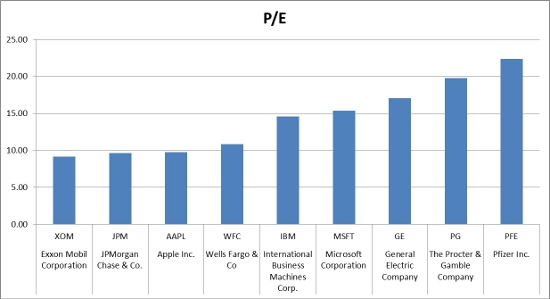
To this analysis, I would like show how cheap these stocks really are. While I try to not compare the P/E ratio of non-competitors, I think it is valid for this one exercise.

If we look at the P/E and EPS of these companies, it is quite telling how cheap Apple really is among this peer group.


Company

Symbol

P/E

EPS

Apple Inc.

AAPL

9.78

44.10

Exxon Mobil Corporation

XOM

9.17

9.69

Microsoft Corporation

MSFT

15.39

1.82

Pfizer Inc.

PFE

22.36

1.26

International Business Machines Corp.

IBM

14.57

14.41

JPMorgan Chase & Co.

JPM

9.64

5.20

Wells Fargo & Co

WFC

10.85

3.36

The Procter & Gamble Company

PG

19.76

3.90

General Electric Company

GE

17.08

1.39


It might not be obvious from looking at the above table of values. Looking at P/E as a chart shows that Apple is one of the cheapest stocks by comparing its price to the earnings of the company.

Apple's PE compared to the most profitable companies


It really becomes obvious then by looking at the earnings per share in chart format!

Apple's EPS compared to the most profitable companies


So if you think that Apple’s days are done, you may want to think again! In fact, the biggest complaint that you can say about Apple is it seems that they are not getting enough shareholder value! 

If you think that IBM is fairly priced for its earnings then it would be realistic that Apple could increase its share price by 50% if you focus on P/E! By looking at Microsoft, you could say that the price could go up 60%! This means that it is likely that Apple has more upside potential than downside risk.

My disclaimer on this site consistently says that I ‘might’ be long any stock I talk about. In this case, I am long on Apple as I write this article. However, as I consistently point out in my book, The Confident Investor, I didn’t pay for those shares! My current Apple holdings are all free.  If you want to know how to get free stock in great companies, I suggest that you read my book. You can purchase my book wherever books are sold such as Amazon, Barnes and Noble, and Books A Million. It is available in e-book formats for Nook, Kindle, and iPad.