This isn’t a political blog and I don’t want to talk politics here very often. Like many Americans though, I have been watching the various political debates in the hopes of understanding the issues better and making an informed voting decision.

One of the comments that has come up lately is the privatization of Social Security. Evidently, Mr. Romney and Mr. Ryan supported this idea when it was proposed by President Bush several years ago. Mr. Obama and Mr. Biden are currently pointing out how terrible life would be if we had pursued such a measure.

I don’t follow the logic. Let’s assume that this privatization wouldn’t have taken place until 5 years ago (1 year left in the Bush administration). It is nearly impossible to understand a program that was never enacted so I am going to make some broad assumptions.

  1. My first assumption is that the federal government would never transition all of the FICA taxes to the private accounts since the government needs this money to pay its current bills.
  2. My second assumption is that a significant portion of the investment would be bonds and not in stocks. Having more money chasing bonds would lower the costs of operating the government. Also, since the “stock market” is too big of a monstrosity to gauge  let’s just focus on the S&P 500. It is reasonable that a portion of the privatized investments would be targeted to that group of companies.
  3. My third assumption is that only younger workers would be able to contribute in this manner as they can withstand short-term decreases in the market. These younger workers would keep their money in the fund for 15-20 years before retiring.

The S&P 500 has increased in value about 50% in the last 4 years (it was about 940 on 10/17/2008). I do not believe the the Social Security bank account has increased in value that same amount. It seems that this level of increase would be a good thing for retirees. Granted, that first year of the 5 year window, the index didn’t do as well. Since FICA would have been invested at least quarterly, Social Security funds would be significantly ahead as the growth increased over the last 4 years.
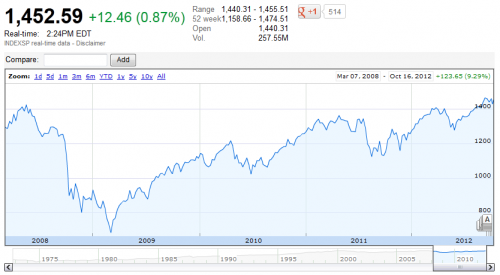
Graph of S&P 500 over the last 5 years

Image is from Google Finance 

The criticism assumes that the investment of that much capital wouldn’t have affected the stock market itself. I don’t believe that this is true. Let’s do some simple math that doesn’t truly take into consideration any other affects this influx of capital would have on the market.

The S&P 500 companies average P/E for the group is 16.62 and we know that the total market capitalization of the group is 12,880,727,000,000. The earnings for the group would probably not increase significantly with more capital invested in those same companies. We can assume that the market capitalization would increase by the amount of capital invested by the FICA contribution.

For arguments sake, lets say that the law would allow 20% of the FICA contribution to be invested equally in the S&P 500 companies. I realize that this is a bit naive but lets stick with that assumption for now. We can be reasonably confident that the government would never have allowed 100% of the contribution to be privatized (see assumptions above) and 20% seems like a reasonable guess for a law that was never enacted. The following table taken from data supplied by the Social Security Administration shows the FICA tax generated about $3,256B in revenue to the US federal government in the previous 4 years and the first months of this last year.

2008 $674B
2009 $669B
2010 $641B
2011 $669B
2012 $603B (partial year obviously)
Total 5 year $3,256B
20% for S&P 500 investment $651B

Therefore, the price that was paid for the S&P 500 (market capitalization) would be increased by $651,000,000,000 and would now be $13,531,727,500,000.

If earnings in that group are the same as today, this means that the average P/E would be 17.46. This is an increase of about 5% over today’s P/E of 16.62.

Eventually this would reach steady state. Workers would start to pull money out of the market as they approached retirement or were in retirement. The natural increase would be about 1% for the average length of time workers would leave money in the account so approximately 20% assuming a 20 year average contribution. However, different from the current status of the accounts, it is possible that this money could be left to heirs where now social security is lost to the federal government. As more wealth was generated by this privatization, the need for ‘traditional’ social security would ease for workers thus allowing it to be more useful for the disadvantaged, very poor, or disabled.

It is reasonable to assume that this model is far too simplistic. It is likely that other investors (non-SSA based) would feel the S&P 500 stocks were over-priced at these levels and would move some of their investment dollars to non-S&P500 companies. This spill-over effect would also raise the price of those stocks. Basically, the influx of FICA money into the system would cause an inflation of stock prices and investment vehicles. This inflation would be beneficial for many companies as they try to raise capital to grow business – there would be more money available in the system to grow business.

If you believe that the stock market is an instrument for companies to find capital to drive their business (as I believe) then you would assume that this much money chasing equities would make a fantastic boon to business. More companies would have access to capital and more companies would be able to go public to accelerate their growth. More companies that can grow fast means more workers need to be hired.

While most efforts by the government to stimulate the economy and stimulate jobs fail miserably, the privatization of Social Security would likely have been one technique that would have accelerated growth of the US economy like no other vehicle. It also satisfied the Libertarians in all of us as it is not the government doing this work but simply US workers using their cash to save for their retirement.

I realize the issue is far more complicated than I have described. I understand better than most that any investment is fraught with risk. However, US workers driving the growth of the economy by helping US employers seems like a good thing.

Not only would US workers have more financial security if their FICA tax was invested for them rather than the current system but the market would be much larger and it would be an economic boon to companies that look for capital.

So, why is Mr. Obama and Mr. Biden saying that Mr. Romney and Mr. Ryan are wrong for supporting this in the past?
Market Watch just did a quick story on John B. Sanfilippo & Sons [stckqut]JBSS[/stckqut]. I really haven’t followed the company so it intrigued me.  In my initial evaluation, the company would probably rate a Fair on my Confident Investor Rating scale. The intriguing thing was the unusual reason it did not come out as a Good company.

Typically, companies drop off of the Good list because they are poorly run. Most often it is not because they did not increase their sales enough but rather the earnings were not growing well enough. This typically means that costs are increasing faster than revenue.

John B. Sanfilippo & Sons is different. The increase in the EPS and EBIT is excellent and the P/E is growing nicely. It is their sales revenue that is not growing well enough, in my opinion, to make the Good list. This is usually the easiest thing for a company to fix – it simply means better execution from the sales and marketing department. Increasing earnings means the company needs to increase sales AND control costs – much tougher to do if the controls are not already in place.

In my mind, John B. Sanfilippo & Sons appears to have some good management in place. Now they just need to hire some excellent sales and marketing types to drive the top-line growth. Since it is a family-run company, let us hope the managers make this investment.

Here are a few excerpts from the Market Watch article for you to enjoy. You should click through to read the rest.

But the nut stock that intrigues me most is John B. Sanfilippo & Sons, a family-controlled company based in Elgin, Ill., that processes and markets peanuts, cashews, almonds and other nuts. It’s been around since 1922.

It owns the Fisher Nuts and Orchard Valley brands and produces private-label nuts for a lot of big retailers, including Wal-Mart.


Adam Strauss, co-manager of the Appleseed mutual fund, is a big investor and a fan. He explains that the company has become more proactive in recent years about marketing and focusing on the consumer. Earnings, he says, are also artificially depressed on the books as the company takes a big depreciation charge for a new facility in Illinois.


John B. Sanfilippo & Sons stock went, er, nuts during the Atkins Diet craze last decade, hitting $50 at one point. Today it’s $13. It’s come back down in recent months, after a huge run-up in the past two years. Small company stocks are volatile, of course: It just takes one or two big sellers to mark it down.

There are concerns in the nut business, like anything else. Commodity prices have been incredibly volatile in recent years. Consumers are watching their budgets these days. And raw nut prices tend to rise faster on the way up than the company can raise its own prices: The lag can squeeze margins. The company, furthermore, does not pay a dividend. The Sanfilippos own 68% of the voting stock. You’re an outsider.

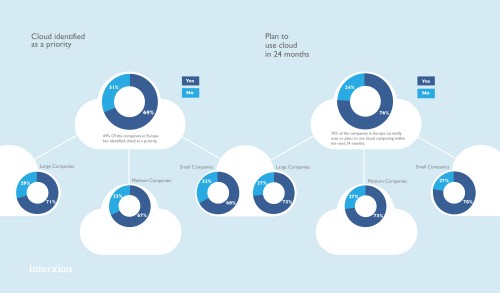
This infographic shows that cloud computing is a major factor in the minds of IT executives. There are several ways to play the cloud computing wave with companies that are on my Watch List.

Google [stckqut]GOOG[/stckqut]

Google Inc. (Google) is a global technology company focused on improving the ways people connect with information. The Company generates revenue primarily by delivering online advertising. As of December 31, 2011, the Company’s business was focused on areas, such as search, advertising, operating systems and platforms, and enterprise. Businesses use its AdWords program to promote their products and services with targeted advertising. In addition, the third parties that comprise the Google Network use its AdSense program to deliver relevant advertisements that generate revenue. In June 2011, it launched Google+. In September 2011, the Company acquired Zagat. In May 2012, Google acquired Motorola Mobility Holdings, Inc. As of January 2012, over 90 million people had joined Google+. In April 2011, the Company acquired PushLife. On July 31, 2012, it acquired marketing start-up Wildfire. In September 2012, it acquired VirusTotal and Nik Software. (This text is from Google).

Akamai [stckqut]akam[/stckqut]

Akamai Technologies, Inc. (Akamai) provides content delivery and cloud infrastructure services for the delivery of content and applications over the Internet; ranging from live and on-demand streaming video capabilities to conventional content on Websites, to tools that help people transact business and reach out to new and existing customers. The Company provides private content delivery networks, Internet-based delivery of applications, such as store/dealer locators and user registration, software distribution capabilities, real-time ad targeting solutions, content targeting technology and enhanced security features. It offers application and cloud performance services, solutions for digital media and software distribution and storage, Website optimization services, network operator solutions, online advertising-related services and other specialized Internet-based offerings. In March 2012, the Company acquired Cotendo, Inc. In September 2012, the Company acquired FastSoft Inc. (This text is from Google).

Amazon [stckqut]amzn[/stckqut]

Amazon.com, Inc. (Amazon.com) serves consumers through its retail Websites and focuses on selection, price, and convenience. The Company’s four customer sets include consumers, sellers, enterprises and content creators. It also manufactures and sells Kindle devices. It offers programs, which enable sellers to sell their products on its Websites and their own branded Websites and to fulfill orders through it. We serve developers and enterprises of all sizes through Amazon Web Services (AWS), which provides access to technology infrastructure. In addition, it generates revenue through other marketing and promotional services, such as online advertising, and co-branded credit card agreements. The Company operates in two segments: North America and International. In June 2012, the Company acquired the publication rights from Avalon Books to over 3,000 backlist titles predominantly in the Romance, Mystery and Western categories. (This text is from Google).

eBay [stckqut]ebay[/stckqut]

eBay Inc. (eBay) is a global commerce platform. The Company enables commerce through three reportable segments: Marketplaces, Payments and GSI Commerce (GSI). These segments provide online platform, services and tools to help individuals and small, medium and large merchants globally to establish online and mobile commerce and payments. In addition, through X.commerce, it has created an open source platform, which provides software developers and merchants access to its applications programming interfaces (APIs), to develop software and solutions for commerce. As of December 31, 2011, it had more than 100 million active users transacting on its sites, millions of merchants using one or more of its platforms, and a developer community with more than 800,000 members using its APIs. During the year ended December 31, 2011, the Company acquired Brands4friends and GittiGidiyor. In May 2012, PRIMEDIA announced that it completed the acquisition of eBay’s Rent.com subsidiary. (This text is from Google).

The above infographic was not created by me. It was originally found on CloudTweaks. It is my belief that CloudTweaks owns the copyright to that image and all of its rights. It is recreated here simply for the convenience of my readers but they are encouraged to click through to the original site to see the full details of the infographic.


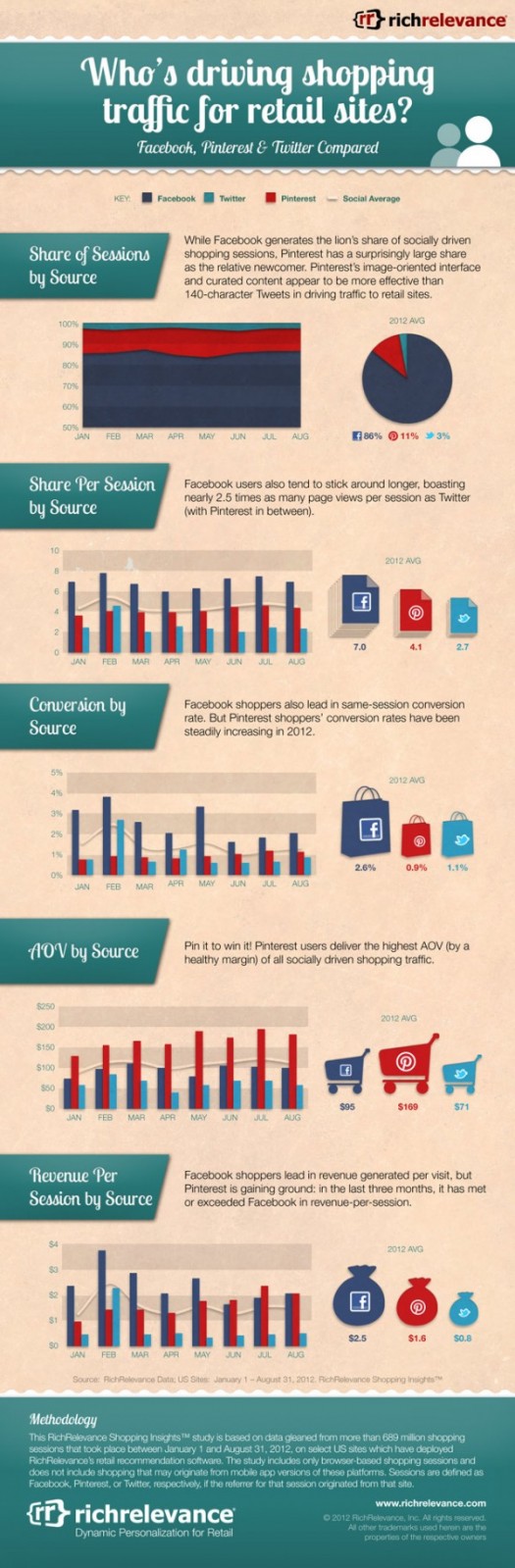
I realize that Pinterest and Twitter are not public enterprises so you cannot truly take advantage of this Infographic in your investing strategy. Many investment advisers suggest that the investor should choose companies that have a “moat” around their business. While I don’t fully subscribe to that theory, there is no question that businesses that have a very strong advantage in the marketplace tend to be more profitable. Great examples of large moat companies are Ansys [stckqut]anss[/stckqut] and Balchem [stckqut]bcpc[/stckqut] which appear on my Watch List and have for quite some time.

The below infographic appears to show that Facebook [stckqut]FB[/stckqut] is currently the leader in generating shopping activity at its partners’ sites but its moat is not very wide. Pinterest is a relatively new company and it is already showing signs of impacting shopping behavior.

The following infographic was found on Blog Herald but appears to originally come from richrelevance. I did not do this study nor does the following image belong to me.

Shopping-Traffic-From-Social-Networks-Infographic

As regular readers know, I am not a pure lover of P/E ratios. I am frequently concerned that companies are passed over by investors due to some silly belief that an investment’s P/E is too high. This ratio has little usefulness when comparing companies that are in separate industries. P/E is typically a signal of the growth rate of the company, a higher growth rate should earn a higher P/E. So unless you only invest in one type of company e.g. software companies, you need to be very concerned about comparing P/E ratios between industries.

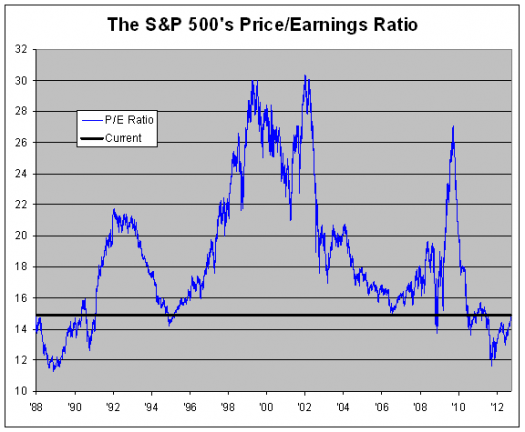
That said, I recently read a very short article on Crossing Wall Street that pointed out an interesting fact. According to the article and the chart, the P/E ratio of the S&P 500 is below the norm for 1991-2010. There are a few brief exceptions to this.

This tells us that the stock market is likely NOT at its peak. While individual companies will go down, in general the market is healthy and investors should continue to use stocks as a major portion of their portfolio.

I am re-posting the excellent stock chart comparison however I didn’t create it and it was originally found on Crossing Wall Street.  I claim no rights to this image.

Historic S&P 500 P/E ratio compared to current P/E ratio